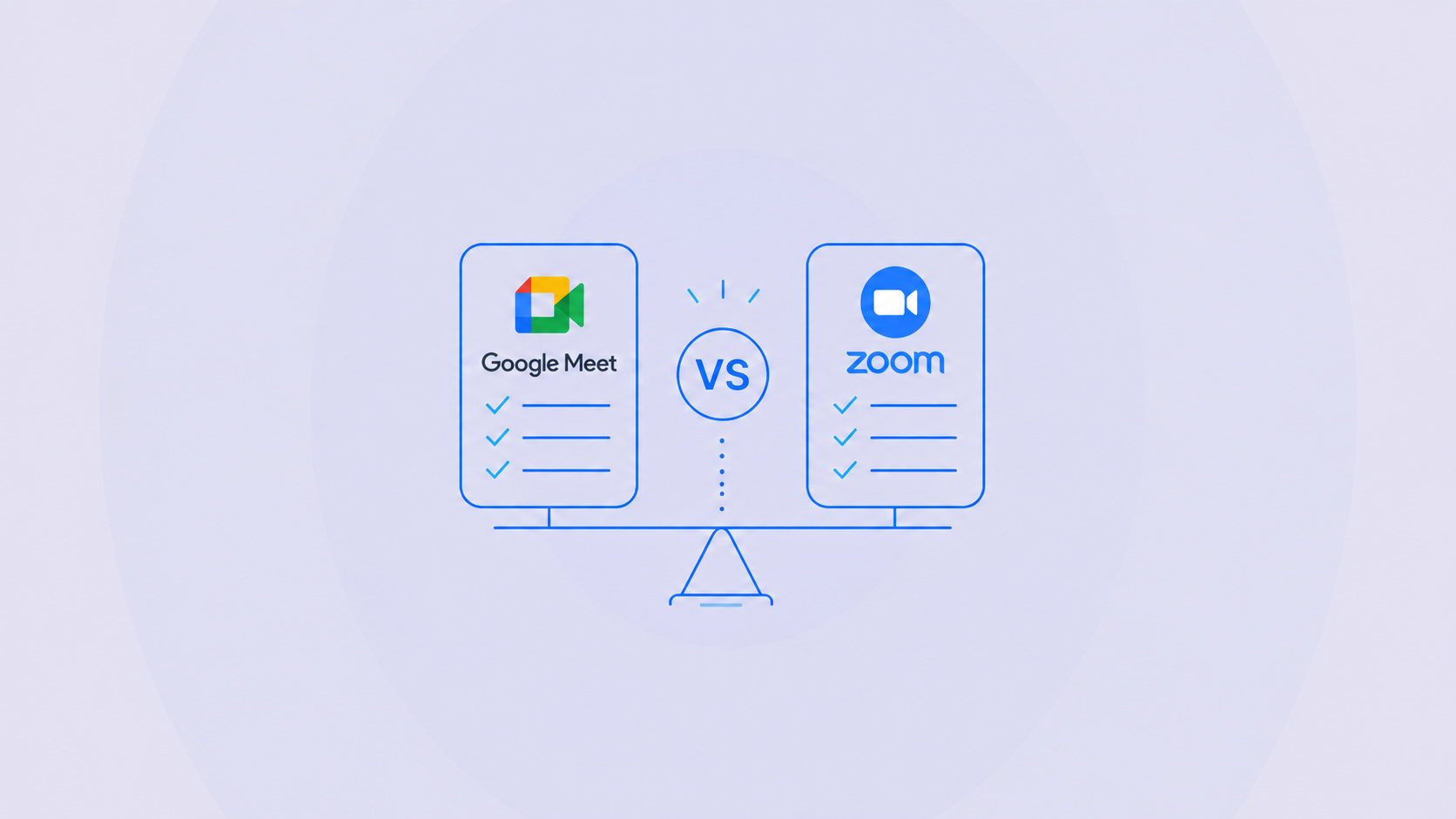
Choosing between Google Meet and Zoom usually comes down to three things: which productivity suite your team already uses, how complex your meetings get, and how much your team relies on what happens after the call. Google Meet fits Google-first organizations and handles standard internal meetings at a lower total cost. Zoom is built for higher-complexity meetings, webinars, and external-facing events. Both have free plans, both added AI features in the last two years, and both have a hard ceiling on what they can do with the work that happens once the meeting ends.
This guide covers pricing, AI capabilities, recording, security, and the layer neither platform was designed to handle: connecting meetings to the email threads, documents, and decisions they're actually tied to. That's where Read AI shines. It runs across both platforms, captures the meeting on whichever one your team uses, and ties the conversation back to the work it belongs to. It also allows you to capture the details of a meeting, whether you attend it or not.
Google Meet's free plan supports up to 100 participants with a 60-minute group call limit. One-on-one calls run up to 24 hours. There's no free recording, and advanced features like breakout rooms and polls require Google Workspace Business Standard at $14/user/month as of early 2026.
Zoom's free plan also supports 100 participants, but group calls cap out at 40 minutes. The trade-off is that Zoom gives free users local recording, whiteboards, and basic polls, which makes the free tier more functional for individual contributors, even with the shorter time limit. Paid plans start at $13.33/user/month (billed annually) for Pro, which removes the 40-minute limit and adds unlimited meeting duration plus Zoom's AI Companion at no additional cost.
For a 10-person team already paying for Google Workspace, Meet adds zero incremental cost. The same team on Zoom Pro pays roughly $1,600/year for the video conferencing layer alone. The economics shift for teams not already in the Google ecosystem, where Zoom's deeper feature set offsets some of the cost gap. The cost story is rarely the deciding factor on its own. Most teams pick based on where their work already lives, then build an intelligence layer on top of whichever platform they choose.
Scheduling in Google Meet is handled entirely through Google Calendar. You create an event, add guests, and a Meet link is generated automatically. Participants join by clicking the link in their calendar invite or email, with no download required on desktop. The browser-based experience is full-featured across all major browsers, which significantly reduces friction for external participants joining from outside your organization.
Zoom's scheduling works through its own app, a calendar add-in, or the Zoom web portal. The experience is slightly more involved on first use because the full feature set requires the desktop application. Zoom's browser client exists but carries reduced functionality, which can create support headaches when external participants try to join from an unfamiliar device. On mobile, both apps are well-developed and comparable in experience.
On the fundamentals, both platforms are competent. Google Meet supports up to 500 participants on Business Plus and up to 1,000 on Enterprise tiers. Zoom supports up to 1,000 participants on its large meeting add-on. Both offer HD video, background blur, virtual backgrounds, and noise suppression on paid plans. Video quality on Zoom has historically held up slightly better under variable bandwidth conditions, a factor worth testing if your team regularly calls from lower-connectivity environments.
Host controls are more granular in Zoom. Hosts can mute all participants, restrict who can share their screen, enable or disable private chat, and configure dozens of meeting-level settings before the call starts. Google Meet's host controls are cleaner and simpler, but that simplicity means fewer options for hosts who need fine-grained control over large or high-stakes meetings.
Both platforms let you share your entire screen or a single application window. Zoom adds tab-level sharing in its desktop client, so you can share a single Chrome tab without exposing your other open windows. Google Meet keeps screen sharing simpler: you choose a tab, window, or full screen, and participants see exactly that. For most business use cases the difference is minor, but in client-facing presentations where accidental disclosure is a real risk, Zoom's tab-level sharing provides a meaningful safety layer.
Annotation and real-time collaboration during screen sharing is an area where Zoom has historically held an advantage. Zoom lets hosts and participants draw on shared screens, highlight with a virtual laser pointer, and save whiteboard sessions. Google Meet's annotation tools are more limited. Neither platform's built-in whiteboard competes with dedicated tools like Miro or FigJam, but Zoom's Whiteboard feature at least functions as a standalone workspace participants can return to after the meeting.
Zoom has the stronger breakout room feature set. Hosts can pre-assign participants before the meeting starts, broadcast messages to all rooms simultaneously, and move between rooms to monitor discussions. Zoom also allows participants to move between rooms voluntarily, a useful option for self-directed workshops. Google Meet's breakout rooms, available on Business Standard and above, let hosts create and assign rooms during a meeting but lack pre-assignment and offer fewer controls for hosts monitoring multiple rooms at once.
For workshops, training sessions, and facilitated discussions, Zoom's breakout room functionality goes deeper than Meet's. Teams running regular workshops should account for this when evaluating plans, since Google Meet's breakout functionality is locked behind a $14/user/month subscription minimum. Breakout depth is only one part of the workflow. The bigger question is what happens to the discussions, decisions, and assignments inside those rooms once the meeting ends.
The free-plan time limit difference matters more than it sounds. Zoom's 40-minute cap on group calls means a standard team standup that runs long gets cut off mid-conversation. Google Meet's 60-minute free limit avoids that problem for most daily meetings. On paid plans, Zoom allows up to 30 hours per meeting and Google Meet allows up to 24 hours, though the practical difference at that scale is negligible.
Cloud recording is a paid feature on both platforms. Zoom Pro includes cloud recording with up to 10GB of storage. Google Meet Business Standard includes recording with recordings saved directly to Google Drive. Local recording is available to Zoom free users on desktop, which makes Zoom the more capture-friendly option for budget-conscious teams. Google Meet does not offer local recording on any plan.
Neither platform's native transcription is designed to serve as a searchable, connected record of your work. Both generate transcripts that live inside the platform, disconnected from your email threads, documents, and CRM. That's the functional ceiling for both tools' built-in AI meeting notes.
Zoom's AI Companion is included in all paid plans starting with Pro. It generates post-meeting summaries, extracts action items, and can draft follow-up emails based on the conversation. The Continuous Meeting Chat feature allows participants to interact with AI during the meeting and see threads persist after it ends. Zoom's AI Companion 3.0 also introduced agent-like behaviors that can work across the Zoom platform.
Google Meet's Gemini AI features are tied to plan level. "Take notes for me" and post-meeting summaries are available on Business Standard ($14/user/month) and above. The AI performs well for structured meetings with clear agendas and captures key points reasonably accurately. For real-time translation, Gemini supports 18 languages on relevant paid tiers.
Here's the limitation both platforms share: their AI only sees what happens inside that meeting. If your client call was on Zoom, your internal debrief was on Google Meet, and the follow-up landed in Gmail, no native AI gives you a unified view. That fragmentation has a real cost. For more than half of employees, the only way to find the information they need is to schedule another meeting. That's a direct consequence of the meeting context getting trapped inside the platform that hosted the original call. The decisions, commitments, and context produced in those calls evaporate the moment it ends if there's nowhere else for them to go.
Read AI is the layer that connects across all of it. Meeting summaries, action items, and transcripts pull into a single searchable knowledge base that also includes email and chat. It works whether your team uses Meet, Zoom, Teams, or all three. Transcription alone isn't the product worth building around in 2026. The connections across your work are.
Both platforms meet enterprise security requirements for most organizations. Google Meet uses AES-128 and AES-256 encryption via SRTP/DTLS, and enterprise plans include advanced endpoint management, DLP capabilities, and audit logging. Zoom offers AES-256 GCM encryption, SSO, role-based access controls, and admin audit logs on Business and above. HIPAA compliance and BAA availability are offered by both platforms at the Business Plus and/or Enterprise tier, requiring a signed agreement before enabling.
Single sign-on and SAML support are available on Zoom Business and above, and on Google Workspace Enterprise plans. For organizations in regulated industries, compliance certifications matter. Google Workspace holds SOC 1, SOC 2, and SOC 3 certifications. Zoom holds SOC 2 Type II certification and supports HIPAA, FERPA, and FedRAMP Moderate at the enterprise level.
Google Meet is the natural fit for Google-first organizations. If your team already pays for Google Workspace, Meet is included at no additional cost, works in any browser without downloads, and handles the majority of internal video meetings without setup. The free plan is also more generous than Zoom's for basic group calls.
Zoom is built for teams that need more from their video conferencing platform. Large meetings, webinars, detailed host controls, pre-assigned breakout rooms, and a broad integration marketplace are all areas where Zoom's depth shows up. Teams that host external-facing events or need enterprise-grade customization will hit Google Meet's ceiling sooner.
Pick the platform that fits where your work already lives. The bigger decision is what runs on top of it. Read AI captures meetings on both Meet and Zoom, ties them back to the email threads and documents the conversation is actually about, and surfaces the action items and decisions that would otherwise live only in someone's notes. The platform you meet on matters less than whether the work that follows the meeting connects to anything.
The decision between Google Meet and Zoom ultimately comes down to three things: your existing ecosystem, your meeting complexity, and your budget. Google Meet is cheaper, simpler, and deeply integrated with Google Workspace. Zoom is more capable, more configurable, and better suited for organizations that run high-volume, high-stakes, or high-participant-count meetings regularly.
Neither platform was built to handle the work that follows a meeting. AI summaries help, but a transcript trapped inside Zoom or Google Meet doesn't update the CRM after a discovery call, doesn't tell you what the client agreed to on the follow-up three days later, and doesn't connect the decision your team made on Meet to the Slack thread it's actually about. That's the layer worth solving. Whichever platform you choose, build a meeting intelligence stack that lives above it, not inside it.
The most useful starting move is small. Pick one team where meetings actually drive outcomes, such as sales, customer success, or a project team running on a tight cadence, and instrument what's said and decided in those meetings into something the rest of the company can search and act on. Read AI sets up in under 20 minutes, works across Google Meet and Zoom with no IT involvement, and connects meetings to the rest of the work without locking you into either platform. It also ensures you get all the information you need, connected to the workflows you already use, and you may not have to attend the meeting at all.
For small teams already using Google Workspace, Google Meet is the most economical fit because it's included at no additional cost and requires no downloads for participants. Teams outside the Google ecosystem typically default to Zoom Pro at $13.33/user/month for its broader feature set. Either way, the larger question is what captures the meeting's outcomes once the call ends. Read AI works across both, so the platform decision doesn't lock in your meeting intelligence stack.
Google Meet's free plan allows group meetings of up to 60 minutes. Zoom's free plan caps group calls at 40 minutes. One-on-one meetings have no time limit on Google Meet's free tier. Both platforms remove time limits on paid plans.
Zoom's AI Companion is included with all paid plans starting at Pro. Google Meet's Gemini AI features require Business Standard ($14/user/month) or above. Both AI layers only see what happens inside their own platform. A Zoom AI summary doesn't know what was discussed on yesterday's Meet call, and neither connects to the email threads or documents the conversation is actually tied to. Read AI works across Meet, Zoom, Teams, and the rest of your work surface, so meeting intelligence isn't fragmented by which platform a given call ran on.
Yes. Google Meet is fully functional in any major web browser without requiring a download. Participants can join directly from a calendar link or email invitation. Mobile apps are available but not required for desktop users, which significantly reduces join friction for external participants.
Teams do use both, particularly when different clients or partners default to one platform or the other. Managing transcripts, summaries, and action items across two platforms is where things get complicated. Read AI connects across both, giving you a unified record of what was discussed and what needs to happen next regardless of which platform hosted the call.
Disclaimer: Tools evolve quickly. Features described here reflect capabilities at the time of writing. Verify current feature sets on each vendor's website before making decisions.


%2C%20Color%3DOriginal.png)


