Your team is spread across four time zones. Half are in meetings while the other half are doing focused work. Someone in Singapore needs context from a 9 a.m. EST product review, but watching a 47-minute recording at 11 p.m. is not how anyone wants to end their day. This is why asynchronous communication has become a baseline operating system for hybrid work.
This guide covers what async communication is, the tools and use cases that matter, how to weigh asynchronous and synchronous communication, and how to roll out a playbook your team will actually use. The async movement got the diagnosis right, but the fix has been incomplete because most advice ignores what breaks down when work spreads across platforms: keeping the intelligence from each conversation accessible.
Read AI closes that loop by working across the platforms async teams already use. Slack, Google Workspace, and your meeting tool each hold a piece of the context, as just one example. Read AI connects them into a single searchable layer, so the teammate who was offline can find the answer without chasing it down. As more companies adopt remote work and flexible work arrangements, asynchronous communication becomes essential for keeping team members aligned across time zones. Unlike real-time communication, async communication allows people to respond without needing an immediate response.
Asynchronous communication is any exchange where the sender and receiver are not engaged at the same time. You send a message, the other person reads and replies on their own schedule. Email is the classic example. A Slack thread answered three hours later is async. A Loom video your manager watches before standup is async. Synchronous communication is the opposite: video calls, in-person meetings, phone calls, and rapid back-and-forth chat.
The primary use cases for async work are status updates, written feedback on documents, decision logs, and meeting recaps, video walkthroughs that replace recurring calls, and collaborative editing on shared documents. In business communication, teams often compare synchronous vs asynchronous communication to decide when face-to-face interaction or instant messages are necessary. While synchronous communication supports quick decisions, async communication works better across varying schedules and different communication styles.
Flexibility is the clearest benefit. People work in their own time zones and schedules without surrendering blocks of the day to scheduled calls. Productivity follows directly because constant pings and meeting interruptions are the documented enemy of deep work. Inclusivity often gets undersold: synchronous-default cultures favor whoever sits closest to headquarters, while async lets a senior contributor in Manila weigh in with the same standing as a junior contributor in San Francisco.
Documentation is the superpower because when work happens in writing or recorded video, the record exists by default. The catch is that records only deliver value if someone can actually find them later. That used to mean disciplined tagging and folder structures. AI search now does the heavy lifting, pulling answers out of three weeks of Slack threads, email chains, and meeting transcripts on demand. Teams that pair async-default habits with AI search reclaim deep focus time and onboard new hires faster, because the archive becomes useful instead of theoretical.
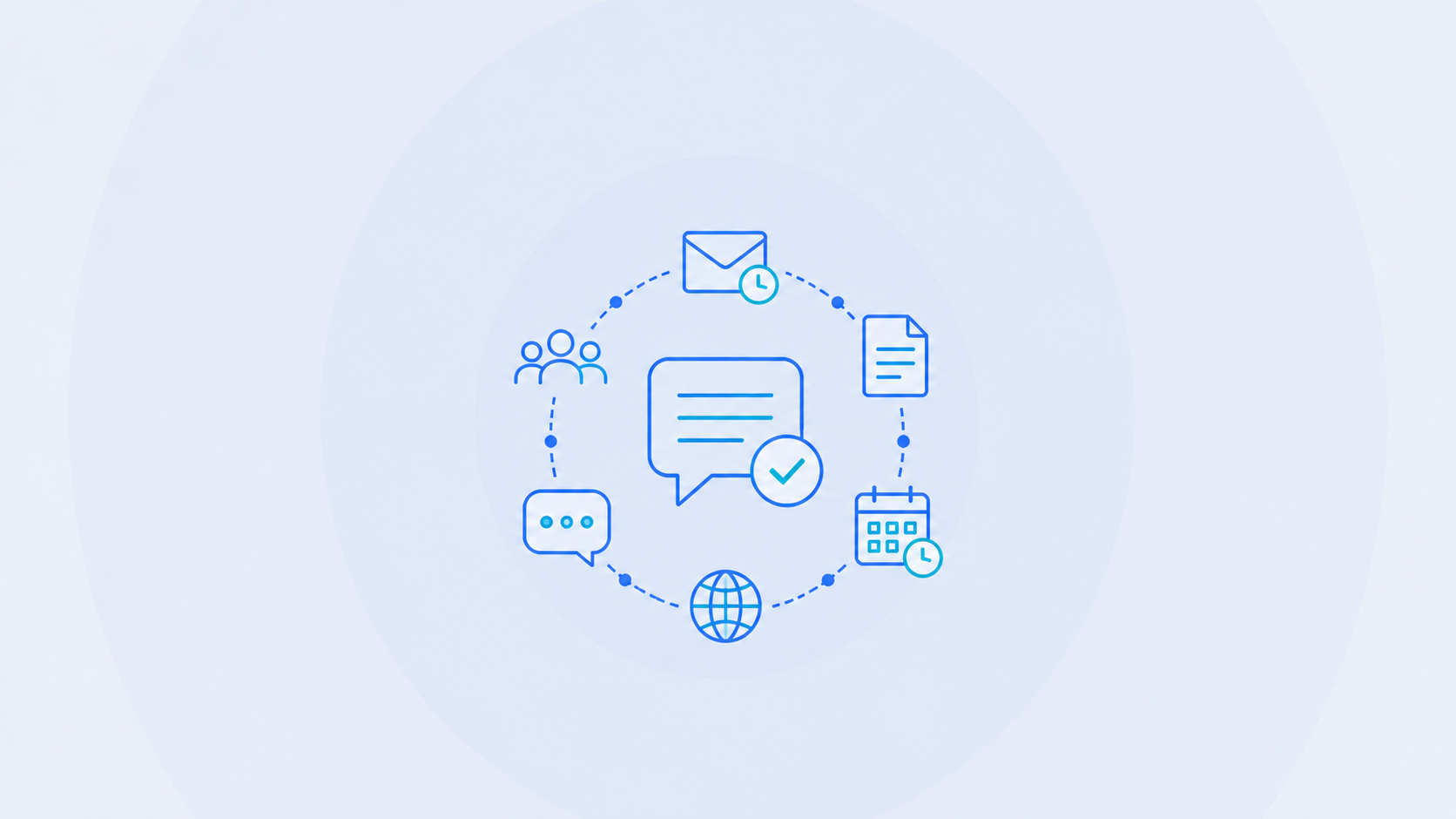
Async tools fall into five categories. Documents and knowledge bases hold long-form content (Google Docs, Notion, Confluence). Messaging and thread-based tools handle daily traffic (Slack, Microsoft Teams). Project management apps assign and track work (Asana, Linear, Trello, Jira). Async video tools capture explanations that would otherwise demand a meeting (Loom, Vidyard). The fifth category is the AI intelligence layer that sits across the other four. Read AI indexes meetings, emails, messages, and connected platforms into a single searchable knowledge base so the context generated in any of those tools stays findable later, and it’s served to you as proactive recommendations just when you need it as well. Pick tools that integrate with the rest of your stack, support threaded conversations, have solid search, and have clear permissioning. Google Workspace deserves a specific call-out because the bulk of teams already have it. Docs, Drive, Gmail, Meet, and Chat together can run a complete async stack with two or three tools layered on top.
A weekly status email is the simplest case: a team lead writes one Friday email with wins, blockers, and priorities, and recipients read it during their own Monday planning. A Slack channel for async discussions is the bread-and-butter example, where someone posts a question with context, and decisions get made over a day or two. Google Drive collaborative editing is async most teams already do, with reviewers leaving comments over 48 hours instead of meeting. A Loom recording converts the most former meetings: a designer records a five-minute screen-share instead of scheduling a 30-minute walkthrough.
Async work principles for teams come down to a few non-negotiables. Default to writing for anything referenced later. Document decisions where people will look for them. Respect agreed-upon response time SLAs. Make context the responsibility of the sender. For hybrid teams, any meeting with both in-office and remote attendees needs a written record so remote attendees are not penalized for not being in the room. A distributed-team checklist: at least two hours of working-hour overlap per pair of teammates, defined channels, quarterly tool audits, monthly virtual rituals, and end-of-day handoff messages on shared projects. For remote teams and remote workers, async work makes it easier to stay connected despite time zones and varying schedules. Many teams rely on communication channels that support written messages, threaded conversations, and nonverbal cues like reactions instead of body language.
Google Workspace gives most teams the spine of an async stack without buying anything new. Start with shared drives, one per team or major project, with subfolders for active work, archived work, and templates. Build document templates for status reports, decision docs, project briefs, and meeting recaps. Configure notifications so people get alerted on direct mentions, replies, and explicit shares, but not every edit. Workspace integrates well with Slack, Asana, Loom, and most other async tools. Read AI sits natively on top of this stack as a Google Add-on, with Inbox Insights summarizing email threads and meeting context surfaced inside Calendar and Drive. That is what turns a collection of apps into a coherent system.
Clear response time SLAs are the foundation. A reasonable default: email within 24 business hours, Slack DM within 4, project management comments within 48, urgent flagged messages within 1. Document decisions and action items every time, with the context, the choice, and the owner captured durably. Write concise subject lines and lead with the headline. Use reactions to acknowledge messages, since a thumbs-up takes a second and removes the anxiety of a sender wondering if the message landed.
Clear written communication is the highest-leverage skill on a distributed team. Train teams to write the way good editors edit: lead with the point, cut what does not earn its place, and reread before sending. Context-rich message composition is the second skill, where a good async message lets someone reading it cold understand what is being asked. That means including the project, background, specific ask, and deadline. AI search shifts the floor here. With Read AI indexing prior meetings and threads, senders no longer have to reconstruct full context from memory, and recipients can pull up what they missed without asking. Tone and inclusive language still matter more in writing because vocal cues are absent, so coach teams to err on the warmer side and assume generous interpretations.
Setting expectations for urgent versus nonurgent items is the first place async cultures break down. Establish a small set of urgency tiers: a flagged Slack DM is urgent, a regular channel message is not, an email is rarely urgent, and a phone call during work hours is urgent by definition. Schedule synchronous check-ins sparingly, because adding a weekly all-hands and a daily standup usually replaces async with sync. Create virtual social rituals to reduce isolation. Audit tool sprawl quarterly, because the simpler the stack, the more the system works as designed. The biggest async challenge is the context that lives in one person's head when they sign off Friday and is needed in Singapore Monday morning. Read AI's Digital Twin, Ada, acts as a proxy on async threads. Looped into an email or message thread, Ada answers routine questions, surfaces past decisions, and hands the work back when human judgment is required. That keeps the handoff moving without pulling someone out of bed for a meeting that did not need to be live.
Define KPIs so the work has somewhere to land. Useful metrics include the percentage of standing meetings replaced by async equivalents, average response time on the agreed SLAs, and the percentage of decisions traceable to a written record within five minutes. Track meeting hours reduced monthly. Read AI's data shows teams that adopt productivity AI see meeting volume drop 20 percent and attendance fall 33 percent, with knowledge workers reclaiming more than 20 hours per month. Survey team satisfaction after pilots: do you feel less interrupted, do you feel adequately informed, would you recommend this way of working to a peer team.
Build an async onboarding checklist covering the tool stack, response time SLAs, documentation conventions, and where the decision log lives. A good checklist lets a new hire be useful in week one without 40 hours of synchronous calls. Short training modules work better than long ones, so build a library of five-minute Loom videos. Run pilot projects with one team first before scaling, with a clear hypothesis and a four-to-six-week window. Collect feedback and iterate, because the first version of any policy will be wrong somewhere.
A company-wide async communication policy is a one-pager naming the channels, the response time SLAs, the documentation expectations, the meeting defaults, and the escalation path for genuinely urgent items. Pilot the playbook with one distributed team for six weeks, then iterate based on results. Scale across hybrid work groups one team at a time rather than top-down, paired with light-touch training and an open Slack channel for questions. Six months in, the cultural shift is durable because every team owns its own adoption.
Async communication has become the operating system of distributed and hybrid work because it respects how people do their best thinking, which is rarely on someone else's schedule. Teams that fumble it bolt async onto a synchronous-default culture without changing the underlying habits. The piece most async strategies miss is the intelligence layer. Slack moves the message, Google Docs holds the draft, Loom records the walkthrough, but no one of those tools can answer the question a teammate has three weeks later or eight time zones away. Read AI is the independent layer that connects them. It is not another app on the stack. It runs across the platforms your team already uses and turns the archive into something actionable.
Common examples include email, Slack threads, recorded videos in tools like Loom, project management updates in Asana or Trello, and comments on shared Google Docs.
Synchronous communication happens in real time with all participants engaged at once: video calls, phone calls, and in-person meetings. Asynchronous communication has a deliberate delay between sending and receiving. Email, recorded video, and most Slack messages outside an active conversation are async.
The main benefits are flexibility across time zones and schedules, fewer interruptions during deep work, built-in documentation of decisions, more inclusive participation, and reduced meeting load. Teams that go async-default typically reclaim 15 to 25 percent of meeting time within a quarter without losing alignment.
A solid async stack covers five categories: documents and knowledge bases (Google Docs, Notion, Confluence), threaded messaging (Slack, Microsoft Teams), project management (Asana, Linear, Trello), async video (Loom, Vidyard), and an AI intelligence layer (Read AI) that indexes across the other four so context from any conversation stays searchable later.
Lead with the point, include enough context that the recipient can respond without follow-up clarification, agree on response time SLAs by channel, and document decisions where people will look for them. Pair those habits with an AI intelligence layer like Read AI that indexes across meetings, emails, and messages, so a teammate who was offline can pull up the answer instead of asking someone to retell the conversation.
Use synchronous communication for sensitive conversations, complex negotiations, real-time problem-solving when async has stalled, brainstorming, and trust-building moments. Roughly one-third of meetings genuinely need to be synchronous. The rest can usually move to async.


%2C%20Color%3DOriginal.png)


