When AI governance works, companies get the upside of AI adoption without the hidden risks. Employees connect their accounts because they trust the system with their data. Sensitive information stays inside the permissions it was meant to live in. Leadership gets visibility into how AI tools are being used, and procurement stops blocking adoption because the security and compliance story holds up.
That's the ceiling. Most AI governance programs don't get there. Companies moved fast with AI adoption and figured out the rules later. Employees connected personal accounts, shared sensitive data through third-party AI tools, and gave AI systems access that never went through procurement or a risk assessment. The tools were useful. The oversight wasn't.
This guide explains what AI governance actually is, why top-down control fails at exactly the moment organizations need it most, and what a governance model built for modern AI looks like in practice.
AI tools now touch email, meetings, messages, documents, and CRM data across companies of every size. Most of those tools were adopted fast, with permission models copied from legacy enterprise software: IT grants access, users share broadly, and nobody audits what actually gets indexed. The result is overexposure in the places it matters most, and under-adoption everywhere else, because employees who don't trust the system stop connecting their accounts.
Read AI is built on a different model. Every user's data stays private by default. Sharing is opt-in, item by item, with no blanket access grants. The internal authorization service runs half a billion permission checks daily to enforce that at scale. SOC 2 Type 2 certification, HIPAA compliance, and GDPR compliance are included, not upsold. Read AI does not train on customer data by default.
The practical result: Read AI's enterprise search is operational in about 20 minutes, with no IT involvement or professional services, and passes procurement in the industries where AI governance requirements are highest.
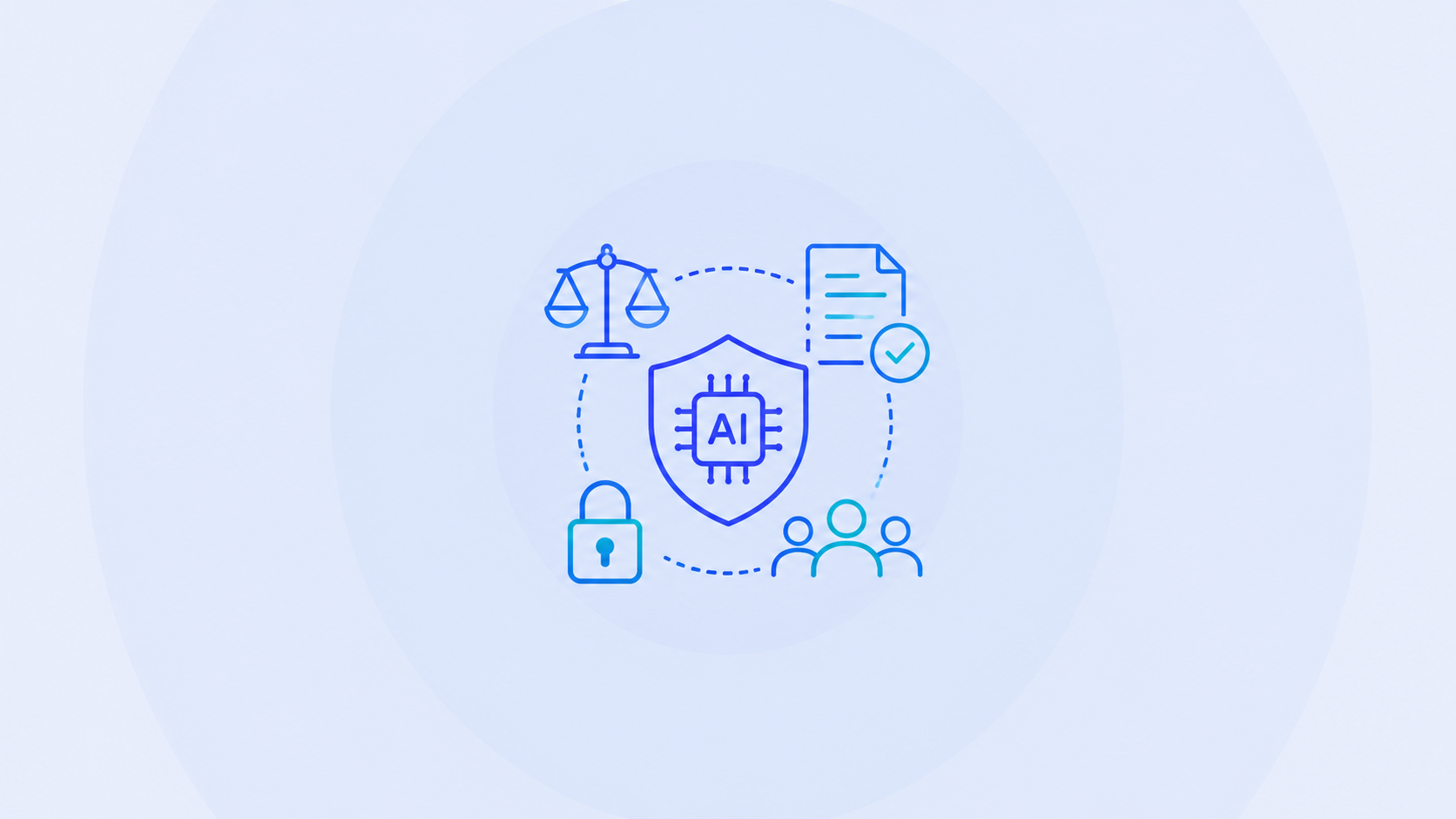
AI governance is the set of policies, governance structures, and oversight mechanisms organizations use to manage artificial intelligence responsibly across the AI lifecycle. It defines what data AI systems can access, who has oversight, and how regulatory compliance is maintained.
In practice, AI governance covers three things:
Most conversations about AI governance start with risk. The real question is adoption.
Read AI's own AI workplace productivity research makes the trade-off concrete: 22% of workers who have not adopted AI tools report having less time to complete tasks than before, even without new productivity tools added. The gap between AI adopters and non-adopters is already opening up in measurable ways. Organizations that slow AI adoption in the name of governance pay for it in productivity lost, and the cost isn't theoretical.
The tension resolves once you understand what actually drives adoption. Employees connect their accounts when they trust the system. They share their data when sharing is opt-in, private by default, and reversible. They stop connecting when governance feels like surveillance. The governance model and the adoption curve are the same conversation, viewed from different sides of the organization.
Cross-platform AI makes this harder to get right than any single-platform tool. Read AI sits above Microsoft, Google, Zoom, Slack, and dozens more of the most popular workplace platforms as an independent intelligence layer, which means governance has to work across every surface at once, not just inside one walled garden.
Governance frameworks still rely on top-down control, where IT or leadership defines what gets indexed and who has access. That approach worked for static systems, but it doesn’t match how AI operates today. It breaks down in two ways.
The people making centralized access decisions don't always have a clear view of how information actually flows across the organization. Blanket access grants create overexposure in the wrong places. Employees accidentally surface sensitive data belonging to colleagues. The governance model meant to reduce risk ends up creating a different kind of risk.
When employees don’t trust that their data stays private, they don’t connect their accounts. The knowledge base stays thin. The AI tool underperforms because the data it can see is incomplete, even when the model itself is strong.
AI governance best practices work at the user level, where each person controls what they share and what stays private. Sharing happens deliberately, item by item, not through organization-wide access grants. The elements that make responsible AI governance work in practice:
Tools built on this model, including AI-powered products like Read AI tend to spread bottom-up across teams instead of stalling in procurement. Read AI’s user-by-user permissioning model is built around this principle: data stays private by default and expands deliberately, item by item.
Regulatory compliance is no longer optional for organizations implementing AI governance. It's the baseline.
For most enterprise environments, the practical starting point is knowing which certifications to require. SOC 2 Type 2 is the baseline for data security. HIPAA applies to healthcare. GDPR applies to organizations handling data from European users. These are the signals that a vendor has built responsible AI practices into the product, not bolted them on after the fact.
Most AI tools are built to maximize what AI models can access. More data means richer answers, which hold up right until the access model breaks.
The legacy model gives IT or leadership control over what gets indexed and who can access it. This is framed as an AI oversight feature. In practice, it creates two problems:
The result is predictable: low trust in AI tools, shallow knowledge bases, and expensive AI development and deployment cycles that don't deliver on vendor promises.
Read AI takes a different position, detailed further in the post on how Read AI approaches permissioning and data governance. The internal authorization service runs half a billion permission checks daily. Data from integrated services like email, documents, and messages surfaces only within each user's own knowledge base by default. No one in the organization can accidentally pull up a colleague's private email thread during their own search. Sharing is always opt-in, always item by item.
Only 10 to 15% of Read AI users opt into data sharing. The product works fully without it. That's what responsible AI governance looks like in practice: a model that works whether employees share broadly or keep everything private, because the data belongs to the user first.
Read AI is built on the principle that governance shouldn't be an afterthought. It should be the foundation on which the product is built.
The permissioning model starts private and expands deliberately. Every user controls their own data. Compliance certifications (SOC 2 Type 2, HIPAA, GDPR) are included, not upsold. Executive leadership teams and IT directors can configure role-based access, set data retention policies, and maintain the kind of human oversight that responsible AI development requires.
Underneath the governance model sits a product architecture most AI tools can't match. 90% of Read AI's processing runs on proprietary models, not third-party LLMs. The Personal Knowledge Graph connects meetings, emails, messages, documents, and connected platform data (like CRM) into a single structure with permissioning preserved at every layer. Read AI's Digital Twin (Ada) and Free Agent technology extend the same governance model into agentic workflows, and Read AI MCP integrations carry those permissions into tools like Claude Code and Cursor, so the rules that apply to search also apply to what AI agents can do on your behalf. Teams using enterprise search for sales see this model in action: deal context surfaces to the rep who owns it, not to the whole org.
Named a Top 50 AI App by a16z and trusted across more than 90% of the Fortune 500, Read AI passes procurement in the industries where AI governance requirements are highest.
Most frameworks focus on transparency, accountability, security, and fairness. Some models add user-level permissioning to keep data private by default.
Data governance manages data quality, access, and security. AI governance defines how AI systems use that data, including access, decisions, and monitoring. You need both.
It depends on location and industry. The EU AI Act is rolling out, while US rules are sector-based. Even when not required, standards like SOC 2 are often expected.
Ownership varies across roles like security, data, and legal leaders. Strong governance requires coordination, but clear accountability is critical.
Compliance checks if you meet regulations. Governance is broader, covering risk, access, accountability, and monitoring beyond just compliance.
No. Read AI does not train on customer data by default. Users control what is shared and what stays private, which is a core principle of responsible AI practices.


%2C%20Color%3DOriginal.png)


