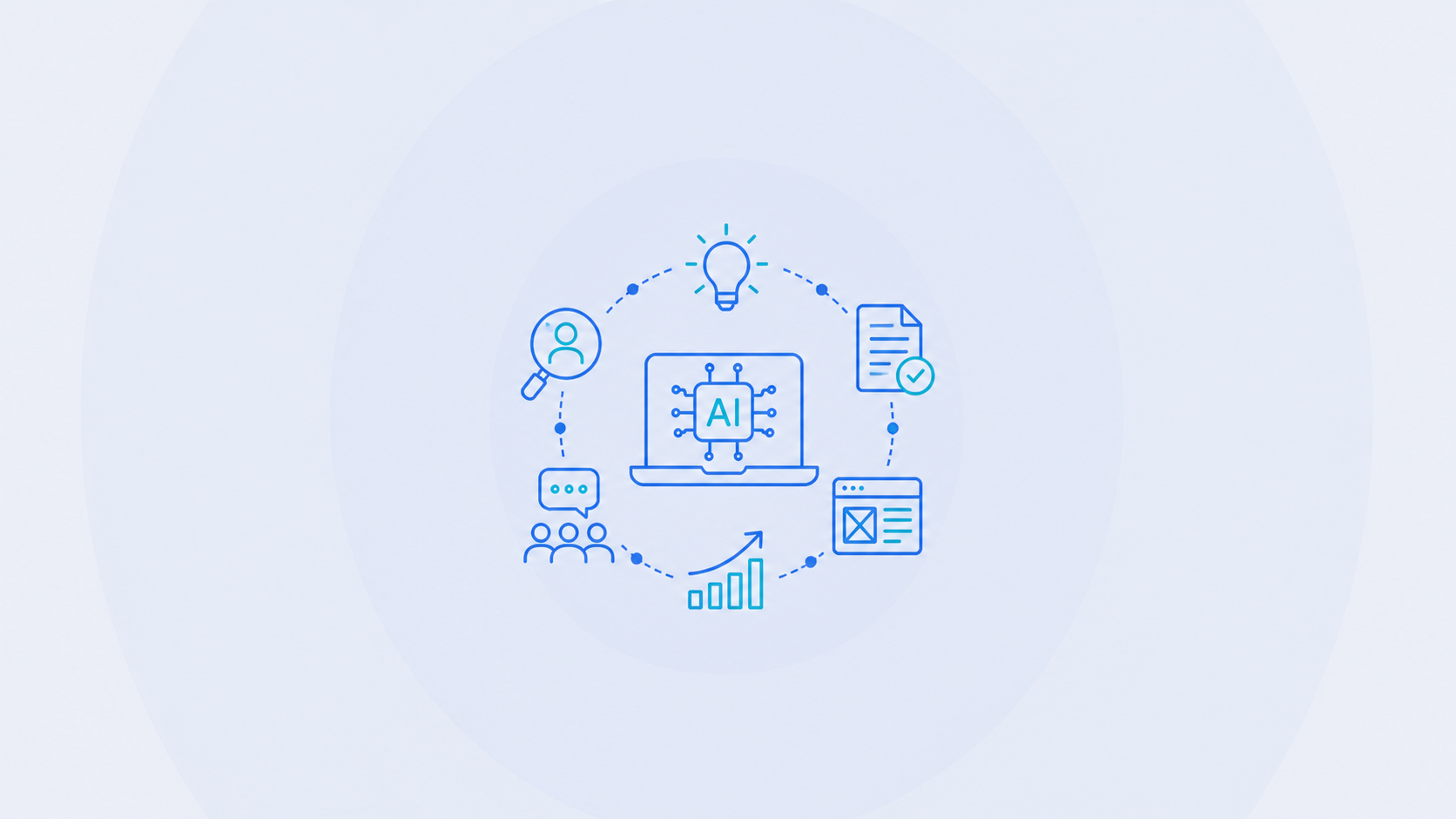
The teams shipping better products right now are not necessarily the ones with the most headcount or the biggest budgets. They are the ones compressing the time between a signal and a decision. AI for product development, when applied systematically across the entire product development lifecycle, helps product development teams compress feedback loops, streamline development workflows, and respond faster to customer feedback and market trends. The competitive advantage no longer comes from simply adopting AI tools. It comes from redesigning the product development process around AI-powered systems that improve decision making at every stage.
• AI's highest value in product development is compressing feedback loops, not just automating documents.
• Teams that build AI into their discovery, spec, and post-launch workflows make faster, more accurate decisions than those using it only for content generation.
• AI-powered product development requires connecting insight sources across meetings, emails, and product data, not treating them as separate inputs.
• The teams pulling ahead are not using more AI, they are redesigning their workflows around it, so knowledge compounds instead of disappearing into folders no one reads.
User insight is everywhere and nowhere at once. Interview transcripts live in one folder. Support tickets are in another system. Slack threads hold half-formed feedback that never makes it anywhere. The problem is not a lack of data. The problem is that the data is unstructured, scattered, and inaccessible when it matters most.
AI-powered product development changes this by turning those scattered inputs into a structured, queryable insight stream. Instead of a researcher manually coding 40 interview transcripts over two weeks, an AI system can surface themes, tag pain points, and flag recurring language across hundreds of interactions in hours. The researcher then validates and interprets, rather than starting from scratch each cycle.
Read AI sits at the communication layer where product decisions actually get made: meetings, emails, messages, and connected platforms. It indexes those sources into a single searchable knowledge base and surfaces context as proactive recommendations the moment a team needs it. Traditional tools index documents and stop there. That is the difference between a searchable archive and an active intelligence layer.
Traditional discovery relies on small sample sizes. A team runs 10 user interviews, a researcher synthesizes the themes, and the output lands in a slide deck that shapes the next quarter of roadmap decisions. That process has a real ceiling: the insights are only as good as the sample, and the synthesis is only as good as the person doing it.
AI-driven product discovery scales that process dramatically. When AI can cluster pain points across hundreds of conversations, detect patterns in support ticket language, and compare stated requests against actual usage behavior, discovery shifts from anecdotal to evidence-driven. A 2025 McKinsey study found that AI-integrated product life cycles improve both speed and quality as teams move from intuition-driven to evidence-driven iteration loops.
One concrete application: using AI to surface latent needs versus stated requests. Users often say they want a faster horse. AI analysis of behavioral data and support patterns can reveal the underlying need for something entirely different. That is where product teams find the ideas their competitors are not seeing.
Product ideation has a well-documented problem: teams anchor on the first few ideas that surface. Anchoring bias is not a character flaw, it is a natural cognitive response to the cost of generating alternatives. AI changes that cost structure.
A product manager can now use generative AI to expand the solution space deliberately, generating 20 distinct approaches to a problem in minutes rather than hours. The value is not in the AI-generated ideas themselves. The value is in what they unlock: the team is now evaluating options rather than defending the first idea anyone had. Research from a P&G field experiment found that AI-enabled teams were three times more likely to produce top 10 percent tier ideas than teams working without AI support.
The risk here is what some call idea inflation, generating too many options without a structured way to evaluate them. The teams getting the most out of AI ideation pair it with explicit evaluation criteria: technical feasibility, GTM fit, UX complexity, and strategic alignment. AI generates the space; human judgment narrows it.
PRDs are one of the most common bottlenecks in the product development process. They take significant time to write, they often lack consistency across teams, and they frequently miss edge cases that only surface later when the cost of addressing them is much higher.
AI for product development can compress this step substantially. Starting from discovery insights, AI can generate structured requirement drafts, identify edge cases the original author missed, and flag inconsistencies with adjacent specs or existing systems. The PM reviews and refines rather than writing from a blank page.
Critically, AI can also maintain traceability, linking insights to requirements and requirements to tickets, so the whole team understands why a decision was made, not just what was decided. That context layer is what prevents scope creep and re-litigation three sprints later.
One of the most expensive mistakes in product development is building something users do not actually want the way it was designed. Traditional methods for catching this, usability studies, beta programs, and staged rollouts, all happen after significant engineering investment has already been committed.
AI changes the sequencing. Teams can now generate realistic user personas grounded in actual customer data, then run structured pre-mortems on proposed features: what would a confused user do with this? Where would a skeptic object? What assumption is this feature making that our users do not share? Harvard Business Review's research on generative AI for early-stage market research confirms that large language models can simulate customer responses to product concepts with meaningful accuracy (for now, for average tendencies) when trained on real user data.
This does not replace user testing. It front-loads the thinking that makes user testing more productive by catching the obvious problems before they consume research cycles.
Misalignment between PM, engineering, and design is rarely about disagreement. It is almost always about context drift, where different people are working from different versions of the same decision. Someone was in the meeting where the rationale was explained. Someone else missed it. Three sprints later, half the team is building toward a subtly different goal.
AI acts as a persistent context layer that prevents this drift. Auto-generated summaries of planning sessions, decision logs, and tradeoff documentation give every team member access to the same shared context without requiring another meeting to get everyone aligned. Read AI captures those conversations across Zoom, Google Meet, Teams, and in-person, then surfaces the relevant context as proactive recommendations the moment it matters, so the team that missed last Tuesday's call is not flying blind in Thursday's design review. The downstream effect is significant. Fewer clarification cycles. Fewer re-litigation conversations. Less time rebuilding shared understanding from scratch every two weeks.
The average product backlog is a graveyard. Tickets that were relevant six months ago sit alongside active priorities. Duplicate requests for the same underlying need are logged separately across different team members. Bugs with unclear severity estimates mix with feature work that has no user impact measurement attached to it.
AI-powered product development can clean this up continuously rather than episodically. AI can cluster duplicate feature requests, flag backlog items that conflict with each other, tie tickets to specific user impact signals from support and usage data, and surface items that have become newly relevant as the product and market have evolved. The result is a backlog that reflects current reality rather than accumulated history.
Product teams have always aspired to be data-driven. The gap between aspiration and practice has typically been infrastructure: getting usage data, qualitative feedback, and revenue signals into the same place and then having someone with the bandwidth to analyze them has been a part-time job in itself.
AI collapses that infrastructure requirement. It can connect disparate signal sources, surface anomalies in usage patterns before they show up in quarterly reviews, detect emerging trends in support volume that predict churn or confusion, and push those findings into the team's active workflow rather than waiting for someone to pull a report. The shift is from periodic reviews to continuous learning, which changes the cadence of decisions fundamentally.
Product and marketing teams frequently disagree about how to describe what the product does. Marketing writes copy in language that sounds good. Product teams often feel it does not reflect the actual capability. The underlying problem is that neither is anchoring to the same source of truth.
AI can extract GTM language directly from the words users themselves use in interviews, support tickets, and product reviews. When a user says "I can finally stop asking my colleagues to repeat themselves in meetings," that is positioning data. AI can surface those patterns at scale, identify the phrases that resonate across multiple user segments, and test positioning variations before campaigns launch. The output is messaging that is grounded in real customer language rather than internally-generated copy.
The period immediately after a product launch is where teams are most at risk of misreading signals. Early enthusiasm can look like traction. Early confusion can look like low adoption. Without fast, structured analysis, teams either overreact to noise or dismiss signals that matter.
AI can auto-summarize post-launch feedback across channels, app reviews, support tickets, social mentions, and sales call recordings, and distinguish between real adoption signals and false positives within days rather than weeks. That speed lets teams make correction decisions while the launch context is still fresh and the cost of adjustment is still low. The learnings feed back into the roadmap in the same sprint cycle rather than sitting in a retrospective document that no one reads.
One of the most underappreciated costs in product development is relearning. A team runs a pricing experiment, learns something critical about user behavior, documents it in a Confluence page, and then 18 months later runs the same experiment because no one remembered the original finding. This happens constantly. The knowledge exists. It just is not accessible.
AI-powered product development addresses this by turning meetings, decisions, and experiments into searchable, queryable knowledge rather than documents that get buried. Read AI's enterprise search pulls answers from meetings, emails, messages, and connected platforms, so the decision context from a planning session six months ago is retrievable in seconds, not in a 45-minute archaeology expedition through old recordings. When institutional knowledge compounds rather than evaporating with each team change, product decisions get smarter over time rather than starting fresh each cycle.
This is the one that separates the teams who are getting ahead from the teams who are running in place while using AI tools. Adding an AI notetaker to existing meetings is an add-on. Redesigning how discovery, planning, and review rituals work because AI has changed what is possible, that is an AI-native workflow.
The practical question is: where does human judgment add the most value, and where is AI better positioned to do the work? Deciding what to build, shaping a product narrative, reading the room in a customer conversation, those require human judgment at the center. Synthesizing research, cleaning the backlog, drafting specs, summarizing decisions, those do not. AI-native product teams have made this distinction explicit and redesigned their rituals accordingly.
AI-native development workflows also help reduce repetitive tasks involved in the product development cycle, including backlog maintenance, documentation, quality assurance preparation, and cross-functional reporting. The goal is not replacing human input. The goal is balancing speed, technical expertise, and product quality across the entire process.
The measure of success is not how many AI tools the team is using. The measure is decision speed, insight quality, and outcome lift. Teams that track those metrics find that redesigning workflows, rather than just adding AI to existing ones, is what drives real improvement.
AI-driven product development is not a feature you add to a team. It is a way of operating that compounds over time. The teams pulling ahead in 2026 are not necessarily the ones with the most sophisticated tools. They are the ones that have been honest about where their process creates friction and then rebuilt those workflows around what AI actually makes possible.
Start by auditing your current workflow against these 12 applications. Where is your team still treating AI as a one-off utility rather than an integrated system? That is where the opportunity is. The teams winning right now did not get there by using AI more often. They got there by learning faster, deciding with better signal, and building knowledge systems that do not start from scratch every quarter.
As AI technology matures, the companies transforming product development are not treating AI as just a tool layered onto old workflows. They are incorporating AI across discovery, software development, launch planning, and post-launch learning to create faster development cycles, stronger market fit, and better cost efficiency.
Read AI is your AI assistant for the communication layer, the place where most product decisions actually get made. It transforms meetings, emails, messages, and connected platforms into summaries, insights, and instant answers, then surfaces that context as proactive recommendations exactly when your team needs it. Product teams use Read AI to keep discovery continuous, decisions documented, and knowledge compounding rather than disappearing between sprints.
The highest-leverage applications are the ones that compress the loop between insight and action: synthesizing user feedback across sources, upgrading discovery from small-sample interviews to pattern recognition across hundreds of interactions, simulating user reactions before engineering investment is committed, and building knowledge systems that let institutional learning compound rather than evaporate. Content generation, drafting specs and tickets, is useful but not where the structural advantage is.
Yes. Product innovation improves when teams use generative AI and machine learning to expand the solution space, simulate customer reactions, and explore design variations before committing engineering resources. Many teams use AI for creative exploration and incremental improvements that increase product quality while reducing development costs.
An AI-native product workflow integrates AI across the full lifecycle rather than adding it to specific tasks. Discovery runs continuously rather than in project phases. Planning sessions are auto-summarized and decisions are searchable. Specs are generated from insights with traceability built in. Post-launch feedback is synthesized in real time rather than at the next retrospective. Platforms like Read AI sit at the communication layer, indexing meetings, emails, and messages so the context behind every decision stays accessible long after the call ends. The key distinction is that the workflow is redesigned around what AI makes possible, not just supplemented with AI tools layered on top of the old process.
Generative AI helps product managers at several specific points in the cycle: expanding the solution space during ideation without anchoring on the first idea, drafting PRDs and user stories from insight summaries, generating pre-mortems on proposed features to surface potential failure modes before build, and extracting positioning language from real user feedback for GTM alignment. The common thread is that AI handles the generation work so PMs can focus on the judgment work, deciding what to build and why.


%2C%20Color%3DOriginal.png)


