
You can't watch yourself present while you're presenting. And coworkers might not give honest feedback about how your communication actually lands.
With an AI meeting coach, you can better understand your meeting performance by getting insights into participant engagement, sentiment shifts, and speaking patterns.
TL;DR:
An AI meeting coach observes and analyzes how you communicate in meetings. It captures what was said and how your message landed with your audience.
Most people remember what they said in a meeting, but they don't know when participants checked out. They can't pinpoint the exact moment engagement dropped or when sentiment shifted from enthusiasm to hesitation. An AI meeting coach catches these moments.
Tools like Read AI's AI Speaker Coach can help by catching signals like speaking pace, filler word frequency, and participant engagement.
The technology behind AI coaching tools works by employing:
A single meeting where you talked for most of the time might be exactly right if you were delivering critical project updates. But if that pattern repeats across every standup, one-on-one, and planning session, you're probably not hearing what your team needs to tell you.
Effective AI coaching identifies these trends by analyzing dozens or hundreds of interactions, revealing insights like:
These signals only become visible with enough data, which is why the best coaching tools analyze your full history rather than individual conversations.
Real-time coaching delivers subtle cues during interactions, like when your talk time increases significantly or engagement indicators show attention dropping. These in-the-moment signals let you adjust before you lose the room entirely.
Post-meeting analysis provides detailed breakdowns with specific moments to review. Instead of rewatching the entire recording, you jump to the exact moment where sentiment shifted or engagement dropped. Read AI's meeting reports include these highlights automatically, so you can review what matters without scrubbing through video.
Meeting insights become more valuable when they connect to what happens before and after. A follow-up email might reveal concerns a client didn't voice during the call. A Slack thread might show how your team interpreted your message differently than you intended. Read AI connects meetings, emails, and messages through Search Copilot, so you see the full story instead of piecing it together manually.
Understanding these four analysis types helps you identify which insights matter most for your communication goals.
Engagement tracking captures attention, participation, and responsiveness throughout an interaction.
A meeting where participants check out didn't accomplish its goal, no matter how well you prepared or how clearly you presented. Engagement data reveals:
With this data, you can restructure presentations to front-load what resonates or add context before topics that typically lose people.
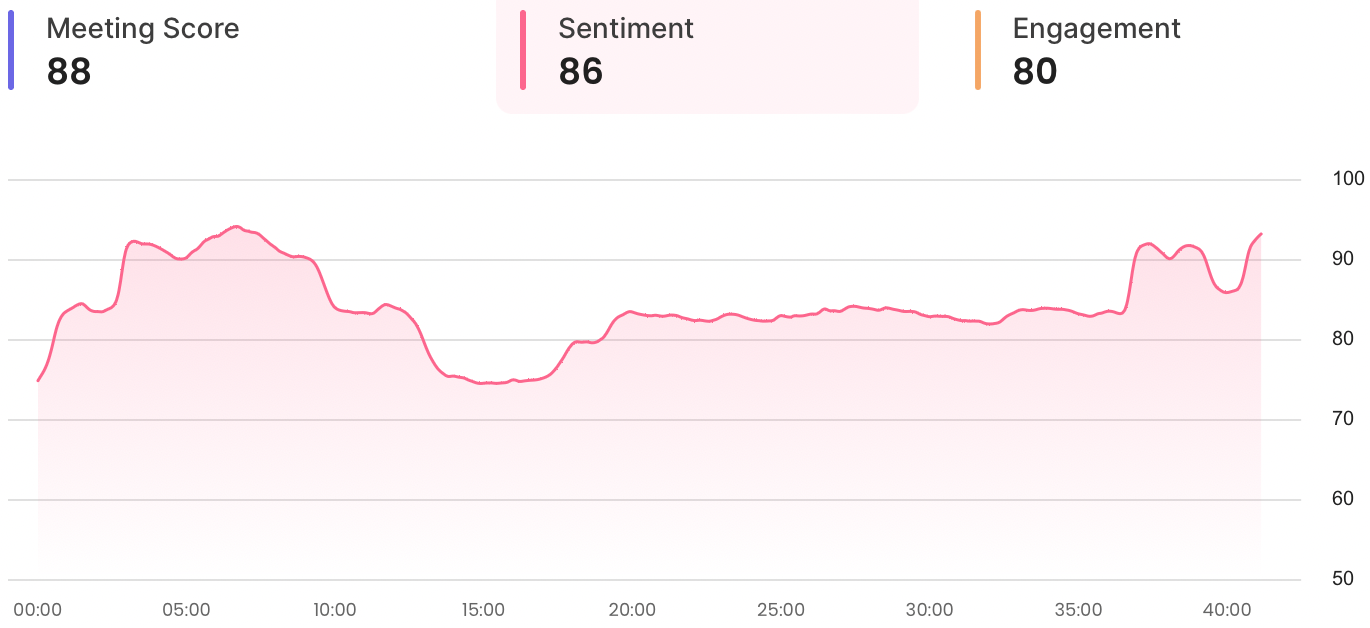
Sentiment analysis aims to understand emotional tone. It catches hesitation, enthusiasm, or concern you might miss while focused on your presentation.
A client's tone might shift from enthusiastic to hesitant during timeline discussions. That hesitation could cost the deal if nobody notices and addresses it. Sentiment tracking flags these shifts so you can respond appropriately.
Read AI tracks both engagement and sentiment scores in each meeting report:
Your talk-to-listen ratio reveals whether you're dominating interactions or guiding them. Pace and clarity affect comprehension, while filler words signal uncertainty or distract from your message.
This type of feedback is effective because it's specific and measurable. Instead of vague advice to "listen more," you see your exact talk time percentage and how it compares across different meeting types. You might discover you lead well in brainstorming sessions but dominate in status updates. That specificity lets you adjust your approach based on context.
Generic advice tells you to "be more concise." Contextual recommendations show you that your standup updates average eight minutes while top performers take three, and attention fades whenever you lead with technical details instead of outcomes. That's specific, actionable, and tied to results you can measure.
Teams using AI coaching see improvements across several areas, with benefits compounding as patterns emerge and coaching becomes more targeted.
Together, these benefits remove the guesswork from professional development and replace it with a data-driven approach to improving how you communicate.
AI meeting coaching is a great way to improve your work performance, but it’s even more powerful when it’s part of a platform that connects information across your entire workflow, not just individual meetings. Read AI captures meetings, emails, and messages, then delivers insights both when you search and proactively through features like Monday Briefing and Topics.
Read AI integrates with 20+ platforms including Zoom, Google Meet, Microsoft Teams, Slack, Gmail, HubSpot, and Salesforce. Start with one metric and one meeting type, like engagement in client calls or talk ratio in one-on-ones. Review your first insights looking for patterns, then connect those patterns to outcomes you care about.
Ready to see how your communication actually lands? Try Read AI for free today.
An AI meeting coach analyzes your communication patterns during meetings, including engagement signals, sentiment shifts, and speaking ratios, and provides feedback to help you improve. Unlike traditional coaching that relies on peer feedback or self-review, AI coaching provides objective data on every interaction.
AI meeting coaches operate through a continuous loop: they capture your interactions, analyze patterns across multiple meetings, and deliver insights both in real-time (during the meeting) and afterward (through post-meeting analysis). The best tools connect patterns across meetings, emails, and messages to show you the broader picture.
AI coaching typically tracks engagement (when attention drops), sentiment (emotional shifts during discussion), speaking patterns (talk-to-listen ratio, pace, filler words), and contextual patterns across multiple interactions. These metrics help identify specific moments and habits to improve.
AI coaching complements rather than replaces human feedback. It provides objective, consistent data on every interaction. But the interpretation and application of that data still benefits from human judgment and context.
Pick a single meeting type where you want to improve: client calls, team standups, or executive presentations. Run meetings with coaching enabled, then review the patterns that emerge. Ask yourself which habits show up repeatedly, and which changes would have the biggest impact on outcomes you care about.
An AI meeting coach analyzes your communication patterns during meetings, including engagement signals, sentiment shifts, and speaking ratios, and provides feedback to help you improve. Unlike traditional coaching that relies on peer feedback or self-review, AI coaching provides objective data on every interaction.
AI meeting coaches operate through a continuous loop: they capture your interactions, analyze patterns across multiple meetings, and deliver insights both in real-time (during the meeting) and afterward (through post-meeting analysis). The best tools connect patterns across meetings, emails, and messages to show you the broader picture.
AI coaching typically tracks engagement (when attention drops), sentiment (emotional shifts during discussion), speaking patterns (talk-to-listen ratio, pace, filler words), and contextual patterns across multiple interactions. These metrics help identify specific moments and habits to improve.
AI coaching complements rather than replaces human feedback. It provides objective, consistent data on every interaction. But the interpretation and application of that data still benefits from human judgment and context.
Pick a single meeting type where you want to improve: client calls, team standups, or executive presentations. Run meetings with coaching enabled, then review the patterns that emerge. Ask yourself which habits show up repeatedly, and which changes would have the biggest impact on outcomes you care about.


%2C%20Color%3DOriginal.png)


