Zoom selects Read as an Essential App, Premium Features Enabled for Zoom Customers.
RESEARCH REPORT

Power Dynamics in Meetings

The AI-Powered Visibility Leaders Need to Improve Team Performance
Power Dynamics hero image
Editor's Letter
Meetings are among the most expensive activities in any organization—and, paradoxically, among the least optimized. Leaders scrutinize budgets, workflows, tech stacks, and headcount plans with precision, yet meetings often run on habit and hope. Most executives understand surprisingly little about what actually happens inside their meetings, or whether those meetings are effective. 

After decades of studying collaboration and organizational behavior, through my PhD research and hands-on work helping companies fix their meetings, it’s clear that meetings are not neutral spaces. They run on power dynamics. 

The moment a meeting begins, so does the negotiation of status and influence. Who sits at the head of the table. Who speaks first. Who waits. Who interrupts. Who feels safe disagreeing. Who stays on camera and fully present, and who fades into the background. These signals are subtle, but their effects are not. They determine whose ideas take hold, how decisions form, and how effectively teams execute. 

Until recently, leaders had almost no visibility into these forces. Meeting dynamics move too quickly, and the signals that matter most—who held the floor, who hesitated, who disengaged—were too fleeting to reliably detect in real time. Even when something felt off, when one voice consistently overshadowed another, or a remote colleague struggled to get a word in, leaders had little more than intuition to go on. They had no evidence to name the problem or intervene with confidence.

AI changes that calculus. For the first time, leaders can see power dynamics in meetings with precision. This report from Read AI—and the platform itself—makes the invisible visible: shifts in talk time, speaking pace, camera presence, sentiment, and engagement. What once evaporated now becomes measurable, observable, and actionable.

With this visibility, meetings stop being a black box. Leaders can apply the same discipline they apply to any other mission-critical system: spotting issues before they expand, reinforcing norms that drive strong collaboration, and creating conditions where every voice makes an impact.

Rebecca Hinds, PhD

Organizational behavior expert and author,  

Meetings Are Not Neutral Spaces
Too many teams assume their meetings are neutral spaces. Everyone has a seat at the table or the same-sized square on a video call. Everyone sees the same agenda. In theory, everyone has an equal opportunity to contribute. But meetings have never been neutral, and meeting effectiveness varies widely.

Power dynamics—shaped by formal status, role, gender, communication style, and whether someone is in the conference room or dialing in remotely—influence who speaks, who contributes, and whose ideas are taken seriously and adopted. 

For decades, leaders had no practical way to observe these forces as they unfolded. Meetings moved too quickly, and the signals were too subtle for memory or casual observation to capture. Power dynamics play out in fleeting tonal shifts, subtle differences in talk time or speaking rate, and who enters the conversation early versus who waits.

AI changes this. With the right tools, leaders can finally see how their meetings function. The purpose isn’t surveillance. It’s to gain enough insight to help your teams work smarter, faster, and more effectively.

By identifying when airtime is lopsided, where engagement plummets, or where remote participants slip into “ghost mode” (periods when someone remains off-camera and muted, a reliable signal of withdrawal), leaders can intervene in real time and ensure decisions reflect the best thinking—not just the loudest or most senior voice. Equally powerful, participants can see these patterns themselves, helping them adjust how and when they contribute.
Armed with these insights, organizations can redesign meetings with real discipline. They can:
This report breaks down what's really happening in meetings: who dominates, who gets overlooked, and how status, gender, remote work, and different communication styles shape the outcomes. Using anonymized and aggregated data from meetings analyzed by Read AI, and drawing on academic research, we show how these patterns play out, why they matter to team performance, and what leaders can do to run meetings that are more effective, inclusive, and drive stronger business outcomes.
Methodology
The report draws on Read AI’s proprietary meeting analytics dataset, which includes 159,870 virtual and hybrid meetings from public and private companies around the globe, across more than 30 industries and organizational sizes over a recent 60-day period. All data is opt-in, aggregated, and anonymized. We did not use, store, or report any individual- or company-identifiable information for this analysis; all findings are presented only in aggregated, anonymized form; and all analysis of usage trends was conducted using automated content classifiers.
Gender was inferred from participants’ first names. While this approach is imperfect and represents a simplification of gender identity, it enabled an estimated gender distribution across the sample. Formal status was derived from self-reported professional titles, with users classified as either individual contributors (ICs) or managers. We acknowledge that these classifications may not reflect how individuals personally identify or their official roles within their organizations.
The analysis focuses on a subset of observable power dynamics and is not intended to be exhaustive. Rather, it represents an initial deep dive into understanding how AI is reshaping interaction patterns in meetings and the value of greater visibility into those patterns.
159,870
Meetings analyzed
30+
Industries represented
60 days
Analysis period
Formal Status
Formal status is one of the most powerful and persistent forces shaping meetings. Hierarchy shows up the moment a meeting begins—and often for good reason. Senior leaders often speak first and set the early scaffolding that helps teams align around priorities. In many cases, an authoritative voice early in the discussion enables teams to move faster and focus on what matters most.

But authority can also get in the way. Leaders often dominate airtime, sometimes without realizing it, by speaking quickly, interrupting, or unintentionally shutting down contributions from people closest to the work. Junior employees self-censor, wait too long to speak, or stop contributing altogether. Meetings move too fast for memory or intuition to catch these patterns, and organizations rarely see how much hierarchy steers the conversation. The result is decisions that reflect the loudest voices, not the best ideas.

That’s where AI comes in. By making talk-time patterns, speaking order, and engagement visible, leaders can maintain their authority while elevating the right people at the right moments. In our dataset, managers and individual contributors (ICs) end up with nearly equal airtime. Once talk time is normalized by each group’s share of participants, managers speak only about 3% more than ICs—a surprisingly small gap given what prior research would suggest. The takeaway isn’t that leaders talk less. It’s that visibility helps them use their voice more deliberately—maintaining authority and credibility without crowding out critical insight.

AI Levels the Playing Field in Meetings
When AI is present, managers and ICs speak nearly equally, with managers speaking only about 3% more.
That said, correlation isn’t causation. We can’t say whether the presence of AI itself is driving this leveling effect, or whether organizations that adopt AI tools already lean toward more intentional norms. The likely answer is some combination of both.

Status also shows up in language and punctuality. Senior colleagues often use more dismissive or non-inclusive language compared to junior employees who hold back for fear of social penalties—being labeled disruptive, uncooperative, or “not a team player.” Subtle comments (“We’ve already tried that,” “Let’s stay realistic”) can shut down exploration and suppress dissent. But in our dataset, ICs and managers use roughly the same amount of non-inclusive language (about three non-inclusive terms per meeting, on average).
Worst Offender Industries for Non-Inclusive Language
1
Marketing & Communications
2
Real Estate
3
Hospitality & Tourism
4
Investment Management & Advising
5
Retail & Wholesale
Power dynamics often surface in meeting punctuality as well—at least in traditional meetings. Meetings led by senior employees often start late or run long, reflecting the unspoken assumption that others will wait. But here too, we see no meaningful difference in meetings captured by Read AI: For both IC-hosted meetings and manager-hosted meetings, 63% of meetings run over time (the average overrun time is less than two minutes).

For too long, formal status has been anointed and left unchecked. AI exposes what’s working and what’s not, giving leaders the visibility to wield authority deliberately, balancing credibility and influence while ensuring the best ideas, not just the loudest or the most senior voices, rise to the top.
Actionable ways to reduce harmful status-driven power dynamics in meetings
Gender

Gender is another powerful driver of meeting dynamics, shaping who gets heard, how contributions are interpreted, and whose ideas ultimately influence decisions.

Gender shapes how people show up in meetings more than we often realize. Across decades of research—from faculty meetings to scientific conferences—men speak earlier, speak more, and dominate Q&A sessions even when panels are gender-balanced. That creates a familiar challenge for women, because speaking time often gets interpreted as confidence, status, or leadership—advantages that men are more likely to be granted automatically. Researchers call this the “Babble Hypothesis”: we routinely mistake talking more for leading. In one study, every extra 39 seconds of airtime earned someone another “leader” vote, no matter what they actually said.

But when teams use AI, our data suggests the dynamic starts to flatten. In our dataset, women contribute about 9% more airtime than men relative to their representation in the meeting. One likely reason: when people know their words are being captured, summarized, and potentially revisited, that ambient awareness can make participants more reflective about how much they are talking in the meeting. It’s a modern-day Hawthorne effect and one that disproportionately benefits women, whose contributions are more likely to be interrupted, discounted, or overwritten in traditional meeting dynamics. As well, when talk-time patterns are measured and visible, leaders and facilitators can see in real time who’s authentically contributing to move the conversation forward and who’s not, and adjust.

Equal participation matters. Research by Carnegie Mellon University Professor Anita Williams Woolley and colleagues shows that teams whose members contribute at similar rates score higher on collective intelligence—a metric that predicts performance across a wide range of tasks. Teams with more women tend to perform better on this measure, making balanced participation not just a fairness issue but a clear performance advantage.

Speaking rate reflects these dynamics as well. Multiple studies show that men speak somewhat faster than women, and pace is often interpreted as confidence and competence. Yet in our data, we don’t see a meaningful difference: men average about 173 words per minute and women about 171.

With AI Present, Women Speak More
Women account for about 9% more speaking time in meetings with AI.

Historically, studies point to faster talk speeds as a frequent male trait, possibly because of confidence and a desire to convey more information. But when teams are freed from the distraction of manual documentation, everyone can focus entirely on the content, leading to more dynamic, free-flowing, and faster conversations, with more contributions from participants overall. 

Where we continue to see clearer divergence is in language. In many organizations, men use dismissive or non-inclusive language (such as “mansplaining”) more frequently, while women receive less credit for similar ideas. In our dataset, we see this pattern clearly: women use significantly fewer non-inclusive terms (1.7 per person per meeting on average, compared with 2.2 for men). This is consistent with research showing that women tend to rely more on facilitative, connective language that prompts participation and keeps conversations moving. Unlike speaking time or pace, inclusive language is difficult to self-correct in the moment; it reflects years of habits and social conditioning. That may be why we don’t see the same level of flattening here as we do in other dynamics.

Some of the clearest signs of inequity aren’t about who speaks—they’re about who stops speaking. Read AI captures “ghost mode”: moments when someone stays off-camera and muted, a reliable signal that they’ve pulled back from the conversation. In our data, women enter ghost mode 19% more often than men. That gap likely reflects the added cognitive and social burden of constant self-monitoring—sometimes described as the mirror effect—and the extra effort required to remain engaged.

This has real implications. In an analysis of 99 publicly traded companies that use Read AI, teams with low levels of ghost mode grew nearly three times faster than those with high levels. One likely reason is that visible, engaged teams collaborate more effectively—people respond to one another more, share context faster, and stay aligned. And the norms senior leaders set around showing up—being on camera, staying engaged—often cascade through the rest of the organization.

Ghost Mode is a Growth Killer
Teams with low ghost mode grow nearly 3x faster than those with high ghost mode.
Actionable ways to reduce gender-driven inequities in meetings
Remote Work

Hybrid work has introduced a new layer of power dynamics into meetings. People in a physical conference room enjoy various "proximity biases." They often speak earlier, more often, and with more ease. They benefit from micro-interactions remote colleagues never see: the pre-meeting hallway chat, the side glance that cues a handoff, the shared laughter that warms up the room, and the nonverbal signals that help them time their entry into the conversation. 

In our dataset, we see these imbalances clearly. Conference-room participants speak more than five times as much as remote participants (after normalizing talk time by the number of participants in each location). This is the largest gap across any demographic dimension we analyzed.

Why do hybrid meetings show the most extreme power imbalances? When people know they’re being observed—even subtly by AI analytics in virtual meetings—they are likely to regulate their behavior: sharing airtime more evenly, pausing before jumping in, and staying aware of who hasn’t spoken. We can see this effect most clearly in hybrid meetings, where some participants remain visible through analytics while others sit in physical rooms without the same cues. 

Hybrid Meetings Aren’t Equal
Even with AI, remote employees are at a disadvantage. In-room participants dominate the conversation:
5x
More speaking time than remote colleagues
Faster Pace
181 wpm vs. 172 wpm
2x
Nearly 2x more questions:
6.2 vs. 3.7 per meeting
Non-inclusive
More non-inclusive language:
2.7 vs. 1.9 terms per person per meeting
*All figures normalized for group size.

We also see imbalances in speaking pace and participation style. In meetings captured by Read AI, people in the room speak faster (about 181 words per minute compared with 172 for remote colleagues), which can make it more difficult for remote participants to jump in. They also ask nearly twice as many questions per meeting (6.2 versus 3.7 per meeting, on average) and use more filler words (38 words versus 24 words per meeting), both signs of conversational comfort and dominance. Together, these behaviors make it even more difficult for remote attendees to break into the discussion or steer it once it’s underway.

Language patterns tell a similar story. In-room participants use more non-inclusive terms than remote colleagues (2.7 versus 1.9 non-inclusive words per person per meeting). A likely reason is that people in the room feel more comfortable and less scrutinized. They can read the room, gauge reactions, and recover more easily if something lands poorly.

The fact that we see more pronounced power dynamics here (as compared to status or gender) likely reflects the fact that when people are in a conference room, they revert to longstanding bad habits. Without the subtle reminders of AI in the room, the conversation defaults to familiar social dynamics, where the people physically together speak more, interrupt more, and shape the discussion more. In other words, the room reasserts its power because there’s no visible reminder to course-correct in the moment.

Taken together, these signals point to a core reality of hybrid work: proximity amplifies power. When people share a room, the room ends up shaping the discussion. Without intentional guardrails, remote voices fade while in-person voices fill the space.

Unplanned Meetings Now Dominate the Workday
More than 53% of meetings now happen in person or without a calendar invite, and 20% are entirely impromptu.

AI gives teams a way to counteract that drift. By surfacing real-time gaps in talk time, ghost-mode behavior, speaking pace, and acknowledgment patterns, leaders can intervene before remote participants fade out of the discussion.

Actionable ways to reduce hybrid-driven inequities in meetings
Neurodiversity

Cognitive and communication differences shape meetings in subtle but important ways. Traditional meeting formats privilege a certain set of behaviors: fast verbal processing, rapid-fire turn-taking, constant camera presence, and the ability to think out loud. That setup works well for people who thrive in spontaneous, high-tempo environments—but it works far less well for employees who process information differently, including those with ADHD, autism, dyslexia, sensory sensitivities, introverts, reflective thinkers, non-native speakers, or visual processors.

What leaders often interpret as “quiet,” “hesitant,” or “disengaged” is often something else entirely: people operating at a different cognitive cadence. A pause isn’t uncertainty. A slower speaking rate isn’t hesitation. A preference for chat over verbal input isn’t detachment. Without visibility into these patterns, the format of the meeting—not the quality of ideas—determines who gets heard.

The cost of this is real. Many of the strengths associated with neurodivergent or reflective thinkers—pattern recognition, scenario analysis, first-principles reasoning, creative problem-solving—can significantly improve team performance, but only if meeting structures make space for those contributions to surface.

AI-powered meetings can help leaders surface these hidden patterns. Insights gleaned from meeting interactions can reveal signals such as:

  • A contributor who enters the discussion only after several others have spoken.
  • A colleague who switches from verbal comments to chat as speaking rates accelerate.
  • A participant whose engagement drops when agendas or materials aren’t shared in advance of the meeting.
Actionable ways to design meetings that support neurodiverse thinking
Meeting Equity Across Industries

Some sectors naturally create space for women and individual contributors to be heard, while others reinforce hierarchy, speed, or entrenched norms that mute certain voices. By analyzing speaking time, engagement, participation behaviors, and language usage, we can see which industries foster inclusive, balanced meetings and which maintain traditional power dynamics. These patterns have real consequences: they shape who contributes, whose ideas influence decisions, and where early-career employees can make an impact.

Where Women are Most and Least Heard at Work
Industries Where Women’s Voices Dominate
  1. Design & Creative Services
  2. Marketing & Communications
  3. Construction & Engineering
  4. Energy & Utilities
  5. Retail & Wholesale
Industries Where Men’s Voices Dominate
  1. Manufacturing
  2. Emerging Tech & Digital Platforms
  3. Software & IT Services
  4. Hospitality & Tourism
  5. Healthcare
In sectors shaped by hierarchy, speed, or entrenched norms, gender power dynamics are about whose voice is treated as legitimate.

Methodology: Scores are calculated using Read AI’s Dominance Index, a weighted composite of speaking time, engagement, participation behavior (e.g., muting and punctuality), and language usage across meetings. Dominance Index scores are aggregated by gender, then compared within each industry to identify where women speak and participate more vs. less relative to men.

Where Meetings are More Balanced and Where They’re More Hierarchical
Industries With More Balanced Dynamics
  1. Public Sector
  2. Transportation & Logistics
  3. Healthcare
  4. Nonprofit & Social Services
  5. Media & Entertainment
Industries With More Hierarchical Dynamics
  1. Real Estate
  2. Manufacturing
  3. Hospitality & Tourism
  4. Legal & Accounting
  5. Marketing & Communications
In more balanced meetings, work is done through coordination and problem-solving, and more voices matter. Hierarchical meetings have fewer voices and concentrated influence.

Methodology: Scores are calculated using Read AI’s Dominance Index, a weighted composite of speaking time, engagement, participation behavior (e.g., muting and punctuality), and language usage across meetings. Dominance Index scores are analyzed for distribution across participants within industries, and highlight where airtime and influence are shared broadly versus captured by a small number of voices.

Where Individual Contributors (ICs) Make Their Mark
Industries That Amplify IC Voices
  1. Public Sector
  2. Transportation & Logistics
  3. Healthcare
  4. Nonprofit and Social Services
  5. Media & Entertainment
Industries That Limit IC Voices
  1. Real Estate
  2. Manufacturing
  3. Hospitality & Tourism
  4. Legal & Accounting
  5. Marketing & Communications
Higher IC participation often means a team values frontline expertise and cross-functional coordination, and translates to stronger potential for early-career impact.

Methodology: Scores are calculated using Read AI’s Dominance Index, a weighted composite of speaking time, engagement, participation behavior (e.g., muting and punctuality), and language usage across meetings. Dominance Index scores are aggregated by role level (individual contributors vs. managers/leaders) to identify which industries amplify early-career participation and which default to top-down dynamics.

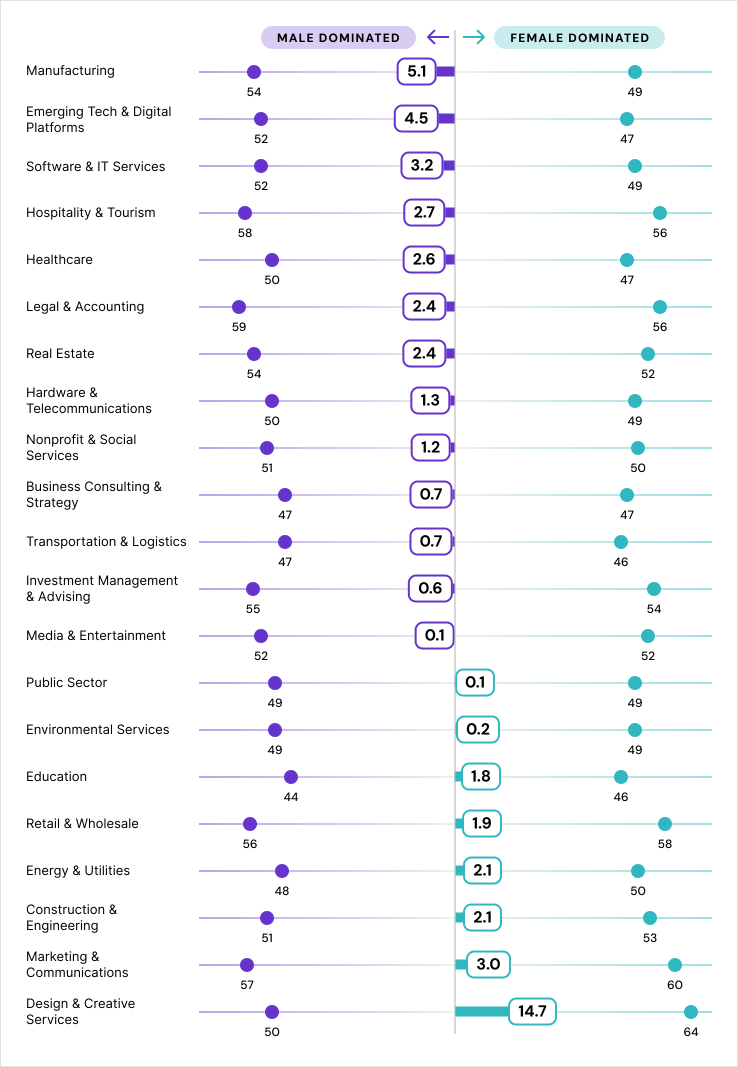
Dominance Index by Industry
A ranked comparison of workplace dominance by gender and industry
Dominance Score in relation to the opposing gender
Dominance Gap Score
Dominance Index by Industry - A ranked comparison of workplace dominance by gender and industry.

Methodology: Scores are calculated using a weighted composite of speaking time, engagement, participation behavior (e.g., muting and punctuality), and language usage across meetings.

Conclusion: A New Era of Meetings

Decades of organizational research have made one thing clear: meetings are shaped by power dynamics. Hierarchy, gender, proximity, and cognitive style all influence who speaks, who gets heard, and whose ideas shape outcomes. What is new is leaders’ ability to see these dynamics clearly, consistently, in real-time, and at scale.

The table below brings together what research has long shown about power dynamics in meetings with what actually happens in meetings analyzed by Read AI. When participation is made visible with AI, long-standing power dynamics tied to formal status and gender begin to flatten. But in hybrid meetings, where it’s easier to overlook the presence of AI, proximity-based imbalances persist.

Power Dynamics Before AI
Power Dynamics With AI
Formal Status
Senior leaders often speak first, talk more, and are more likely to interrupt or shut down ideas—often without realizing it.
Managers and individual contributors are responsible for nearly equal airtime. No meaningful differences in dismissive language or meetings running over time.
Gender
Men often speak earlier and longer, while women face higher costs for interruption and disengagement.
Women contribute more, not less, airtime relative to their representation, speak at a similar pace, and use fewer dismissive terms than males, but enter ghost mode more often.
Hybrid / Proximity
Proximity bias advantages in-room participants through informal cues and conversational ease. In-person participants often speak first and consume more airtime.
In-room participants speak more than five times as much as remote participants, speak faster, interrupt more, and use less inclusive language.

These insights underscore a broader point: meetings aren't just about showing up. They are environments where power, participation, and performance interact in measurable ways. Teams that understand how real contributions unfold—and create norms that surface them—are the ones performing at the highest level today.

How to turn visibility into meaningful performance gains:

With AI as a partner, leaders can take meetings from invisible, habit-driven interactions to deliberate systems that surface the best ideas, strengthen decisions, and drive real business results.

Give everyone a seat at the table with Read AI.

Keep Reading

Sign up for emails to get the latest product updates, benchmarks, and more—delivered straight to your inbox.
Woohoo, you're on the list!
Please fill out the fields above to continue.