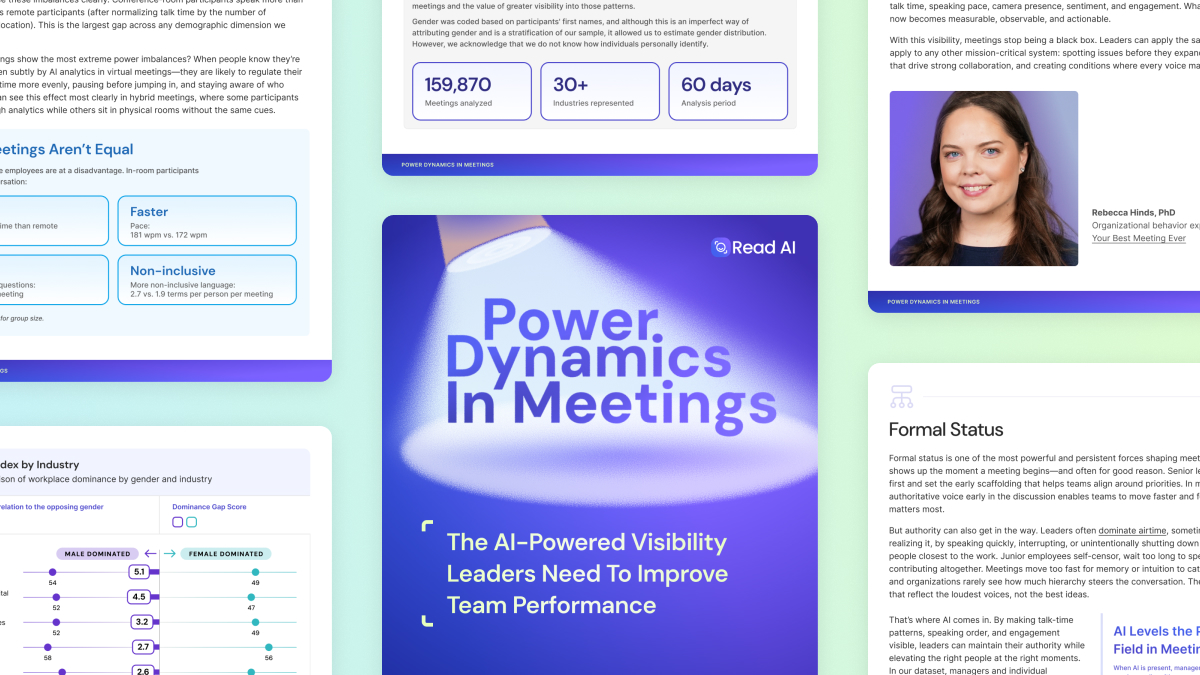
AI arrives in the workplace as a productivity tool and ends up redistributing power for the better. According to the Power Dynamics in Meetings Report from Read AI, women speak 9% more than men in meetings when AI is present relative to their representation, proving to be advantageous for teams looking for stronger business outcomes.
Recent studies confirm the impact of productivity AI on profitability. The EY Pulse Survey uncovered that 94% of organizations investing in AI are experiencing some amount of gains, with 57% claiming that the gains are significant. In another study, Read AI found that publicly-traded companies that use productivity AI saw their share price surpass the S&P 500 by 29%.
The benefits of work AI go well beyond eliminating busywork traditionally owned by women and subordinates. The implementation creates systematic change that boosts women workers as well as other groups. When AI is present, individual contributors speak nearly as often and as fast as managers, eliminating the lopsided conversations and self-censoring that can shortchange career progression and harm productive collaboration.
“As AI changes the power dynamics of workplaces from the inside out, it signals a seismic shift,” says Rebecca Hinds, PhD, and author of the Read AI Power Dynamics in Meetings report. “What teams thought about as pure feature functionality can be so much more. It’s a gateway to stronger business performance.”
According to David Shim, Co-Founder and CEO of Read AI, “The data tells us loud and clear that longstanding behavior patterns are adaptable, and that AI can do the work that organizational training never could.” |
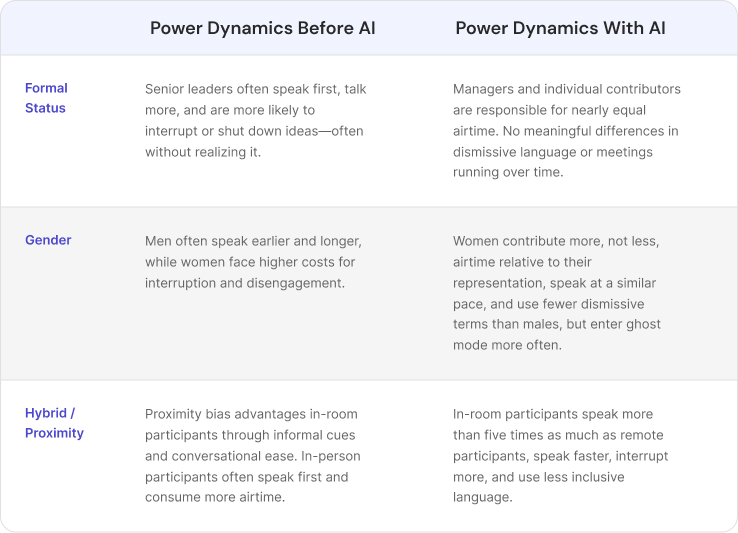
Meetings are not neutral spaces. Across decades of workplace research, men speak earlier, speak more, and dominate Q&A sessions, while women take on more ‘office housework’ Managers control airtime and IC and junior employees wait too long to speak or don’t talk at all. AI changes the calculus. When meetings are captured by AI, women and individual contributors speak more often, matching the talk time of their counterparts and, in the case of women, surpassing them by a sizable margin. This new equilibrium raises a team’s collective intelligence according to oft-cited research from Carnegie Mellon.
Slow and steady speech has long been associated with better understanding at work. Yet the pace of conversation speeds up with AI in the room, increasing opportunities for engagement and elevating new voices without losing clarity. When AI is present, men average about 173 words per minute and women and ICs average 171, a much higher speed than normally clocked for standard meetings. Despite the faster speeds, engagement and sentiment scores remain elevated for both groups.
While AI is integrated into the workplace, some negative traits hold firm, possibly because they are more deeply ingrained. With AI in the room, men still use non-inclusive terms more often than women (two times per meeting on average). Women are also more likely to enter “ghost mode,” staying off camera and on mute 19% more than men when normalized for representation.
Change may be underway, however. When AI is present, leaders and ICs use roughly the same number of non-inclusive terms. Punctuality shifts as well: both leaders and ICs generally arrive on-time and end meetings promptly, going over by no more than two minutes on average.
Ghost mode may soon follow the same pattern. In an analysis of 99 publicly traded companies using Read AI, teams with low levels of ghost mode grew nearly 3X faster than those with high levels, suggesting awareness may be a catalyst for new outcomes.
Power dynamics in hybrid meetings, where there is a mix of in-person and remote employees, aren’t yet improved with AI. In-person workers speak 5X more than remote participants (after normalizing for talk time by location); speak faster than remote workers; and ask nearly double the amount of questions. This shows how deeply in-office workers influence workplace meetings, and reveals a double disadvantage for remote ICs and women in the workplace—a new consideration especially for women who are more likely to work from home in some capacity.
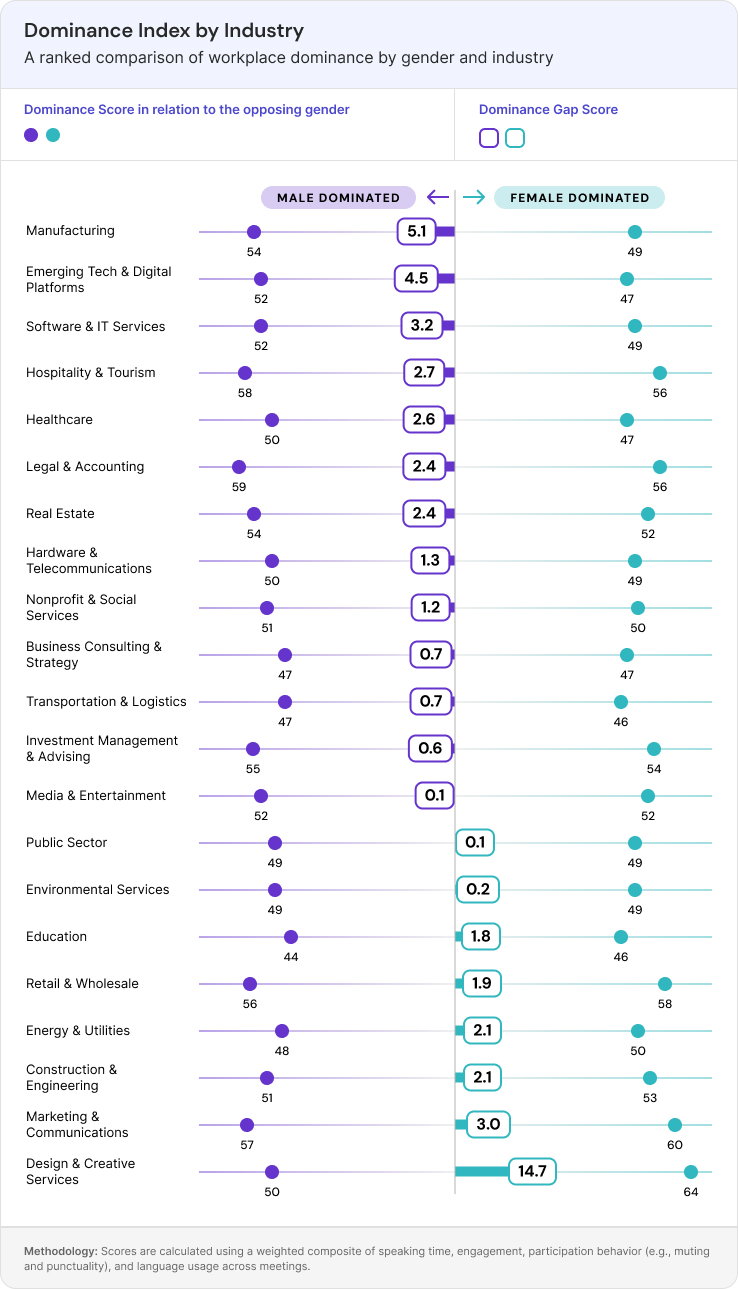
Design, marketing, legal and accounting, tourism, and retail stand out as industries where domineering behaviors persist even with AI in the room, based on a new metric, the Dominance Index. The index combines weighted signals such as non-inclusive language, filler words, and talk-time imbalance to surface where influence consistently outweighs inclusion. Manufacturing emerges as an outlier, sidelining both women and individual contributors in meetings, while real estate shows the strongest manager-over-IC dominance patterns.
Conversely, education, transportation & logistics, healthcare, environmental services, and the public sector offer flatter dynamics and more balanced meeting environments for all participants.
For additional insights, please visit the full report by Rebecca Hinds PhD.
The report draws on Read AI's proprietary meeting analytics dataset, which includes 159,870 virtual and hybrid meetings from public and private companies around the globe, across more than 30 industries and organizational sizes over a recent 60-day period. All data is opt-in, aggregated, and anonymized. We did not use, store, or report any individual- or company-identifiable information for this analysis; all findings are presented only in aggregated, anonymized form; and all analysis of usage trends was conducted using automated content classifiers.
Gender was inferred from participants’ first names. While this approach is imperfect and represents a simplification of gender identity, it enabled an estimated gender distribution across the sample. Formal status was derived from self-reported professional titles, with users classified as either individual contributors (ICs) or managers. We acknowledge that these classifications may not reflect how individuals personally identify or their official roles within their organizations.
The analysis focuses on a subset of observable power dynamics and is not intended to be exhaustive. Rather, it represents an initial deep dive into understanding how AI is reshaping interaction patterns in meetings and the value of greater visibility into those patterns.
Read AI is the most affordable, comprehensive AI assistant on the market, serving nearly 5 million monthly active users. In addition to capturing all meeting notes and safeguarding institutional knowledge, Read AI connects content across platforms, generates answers, surfaces actionable insights, and proactively makes intelligent recommendations to save time and support business outcomes. Co-Founded by David Shim (Co-Founder of Placed, sold to Snap, Foursquare), Read AI was recently named a Top 10 AI Vendor for Enterprises by Brex, Top 50 AI App for Startups by a16z and Mercury, and a Top Seattle Startup by LinkedIn.


%2C%20Color%3DOriginal.png)


