By: Justin Farris, Product, and Elliott Waldron and Luke Woloszyn, Data Science
Meetings continue to increase year over year. Workdays keep stretching longer. Tasks like scheduling, searching, and tracking are eating into the time people spend on their most important work.

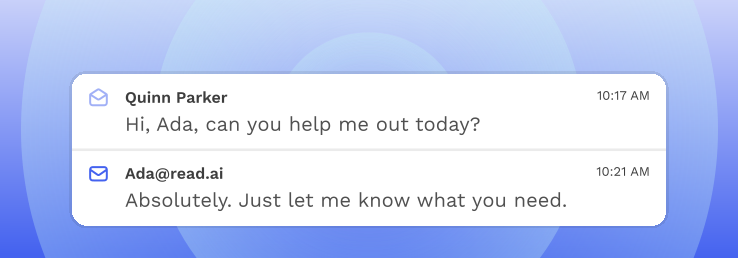
Ada operates as your Digital Twin, available around the clock. Unlike a human assistant who has office hours and competing priorities, your Digital Twin is always ready to respond—whether it's 2 PM or 2 AM, whether you're in back-to-back meetings or traveling across time zones. Your Digital Twin learns from you; it’s your digital representation, designed to work for you. It takes scheduling, searching, and the monotony of busywork entirely off your plate.
When someone emails you to schedule a meeting, your Digital Twin can respond on your behalf, offering times that work with your calendar and preferences. If a scheduling conflict arises, your Digital Twin proactively alerts you and suggests solutions. In a meeting, if you mention scheduling a follow-up, it follows up with you and offers to handle it. And when you need to recall what was discussed in a meeting weeks ago, it can surface that information instantly.
The goal isn't to replace human judgment. It's to handle the routine tasks that don't require it, freeing you to apply your expertise where it matters most.
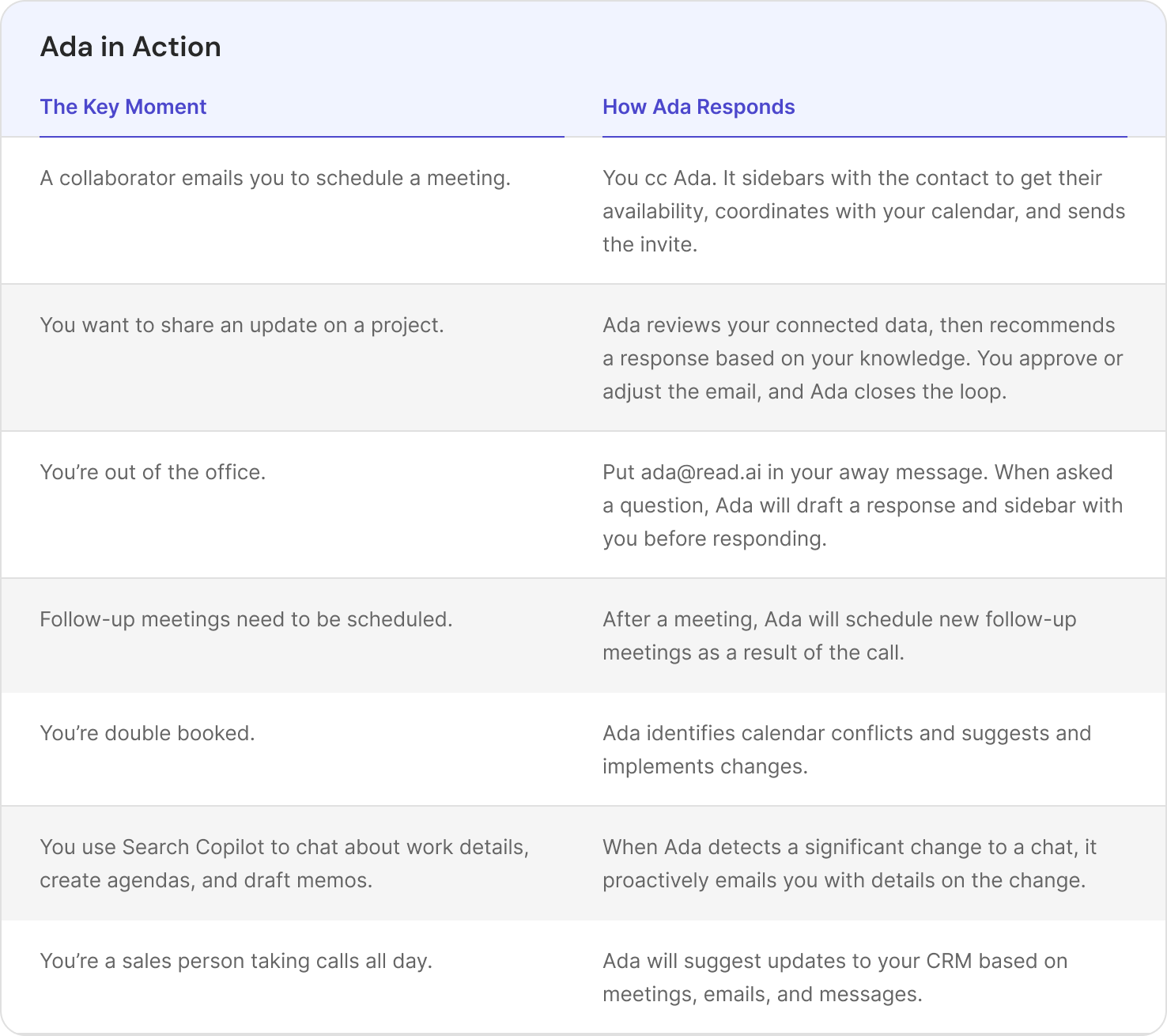

The average professional spends three to five hours per week managing calendars. This doesn’t include the mental overhead of tracking follow-ups, remembering commitments made in conversations, or coordinating across time zones and calendars. Every context switch fragments attention and derails focus.
Task-switching alone can cost up to 40% of productive time. And when administrative work constantly interrupts deep work, the impact compounds. People end up spending their evenings catching up on email instead of recharging, or dropping balls because there simply aren't enough hours in the day.
We built the Digital Twin to solve these problems and more. Rather than offering another tool that requires active management, it works autonomously in the background and can handle scheduling, surface relevant information, and ensure nothing falls through the cracks, all while remembering your preferences.

Read AI already delivers the best solution for meetings, with new customers joining every day for our industry-leading summaries, transcripts, and action items. Yet we have always known that meetings are only one step in the process. We enabled search in early 2025, giving our customers a way to chat with their own personal knowledge graph and allowing us to showcase how proactive support looks in practice. Read AI also evaluates next steps and recommends your next best action, using our behavior-based agents like Monday Briefing.
With all of this information, we’re able to design Digital Twin to predict your needs and act as a steady resource. We’re starting with scheduling and responding to emails, but our near term goal is to enable you to toggle a button and go out of office, and have your Digital Twin keep things moving, and keep you off the grid. And so much more.
Longer term, we believe that a Digital Twin is a human right, akin to internet access. If we said internet access was a human right in the 90's people wouldn't believe it. Now it's an accepted fact.
Digital Twins will act as members of your team, consuming context and predicting what is important to you.
With nearly 1 in 5 meetings occurring with the organizer sending Read AI instead of attending themselves, it's clear that people trust Read AI’s earliest version of a Digital Twin. And now we’re rolling it out to our millions of users, for free.

Read AI’s Digital Twin operates under a single guiding principle: To act like a seasoned executive assistant would act in this moment. That test shapes every decision.
The philosophy is simple. Act autonomously to reduce friction. When there's genuine uncertainty, the Digital Twin seeks guidance rather than guesses wrong. When it encounters genuine ambiguity—conflicting information, unclear instructions, situations where the wrong choice could cause problems—it pauses and checks in. A quick side conversation to clarify is always better than confidently doing the wrong thing.
Its guardrails fall into two categories: hard constraints and soft guidance. Hard constraints are non-negotiable. Your Digital Twin cannot act for users who haven't opted in. It cannot continue a task when the person it's helping has been removed from the thread. It will decline requests it can't fulfill rather than pretend otherwise. These are gates, not preferences.
Soft guidance adapts to context. When should Ada respond versus stay quiet? How much autonomy is appropriate for a given situation? The specifics evolve as we learn from real usage. The core principle stays fixed: act like a thoughtful professional. The guidance for how to embody that keeps getting better.
Some principles are foundational. They won't change. Your Digital Twin will never claim to have done something it couldn't. Before sharing with others any information gleaned from your private content (transcripts, emails, chats, etc.), your Digital Twin shows a draft and asks for approval. When the person who asked for help takes over, your Digital Twin gets out of the way. These are promises.
Other principles are experimental. We're still learning the right balance between autonomy and caution. How long should your Digital Twin wait before following up on a stalled thread? When should it proactively surface a scheduling conflict versus wait to be asked? These defaults are tuned regularly based on how people actually use it. We expect them to keep evolving. User preferences let the Digital Twin adapt further—one person prefers morning meetings, another blocks Fridays for deep work, and it learns to respect both.
The distinction matters for how we communicate. Foundational principles are commitments we make to users. Experimental ones are hypotheses we're testing. Both shape the Digital Twin’s behavior, but only the foundational ones are set in stone.

Just like you onboard a new employee, educate your Digital Twin with context. The more context you provide, the smarter and more proactive it becomes.
Where it differs from a new employee, however, is that the ramp time takes minutes instead of days or weeks. Agents fail when it requires you to ask and train it to complete a one-time action. Your Digital Twin, however, is your digital self, and quickly it knows what to do.
As your Digital Twin evolves, we believe it will fundamentally change how knowledge workers relate to AI. Rather than another tool to manage, it will mature into a true partner that amplifies your capabilities. You focus on the work that requires human creativity, judgment, and connection. Your Digital Twin handles the rest.

Today we’re rolling out Digital Twin to our millions of monthly active users, because we believe every person, around the globe, will want and should have access to personal and proactive AI support. Everyone deserves AI that works for you, that learns from you, amplifies you, and makes you irreplaceable. This is how you future-proof yourself in a world of AI. Digital Twin from Read AI is an extension of you, available for free today.

Accessible directly in your inbox, Ada is free, always on, and built with privacy at its core. Say hi to Ada at ada@read.ai.

%2C%20Color%3DOriginal.png)


